
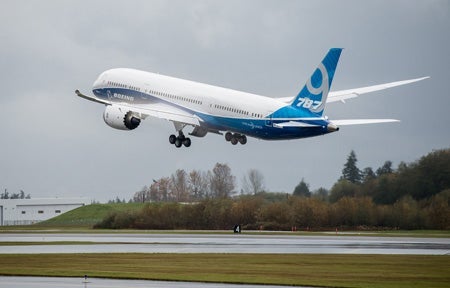
Boeing has contractually delivered the first 787-9 Dreamliner jet to its launch customer Air New Zealand, a key milestone for the aircraft programme.
The move indicates that the company’s progress is on schedule through design, fabrication and testing.

Discover B2B Marketing That Performs
Combine business intelligence and editorial excellence to reach engaged professionals across 36 leading media platforms.
In June, the 787-9 secured the US Federal Aviation Administration (FAA) and the European Aviation Safety Agency (EASA) certifications for commercial service.
The 787-9 is said to feature lightweight plastic components and a new electrical system that replaces heavier metal systems.
Powered by General Electric and Rolls-Royce-manufactured engines, the aircraft is claimed to offer 20% fuel reduction compared with other similar-sized aircraft.
At 20ft longer than the 787-8, the 787-9 extends in capacity and range and can accommodate around 40 more passengers than its predecessor.

US Tariffs are shifting - will you react or anticipate?
Don’t let policy changes catch you off guard. Stay proactive with real-time data and expert analysis.
By GlobalDataThe twin-aisle configured aircraft has a range of 8,300nm and cruise speed of Mach 0.85.
Air New Zealand plans to receive the new 787-9, featuring a striking black livery on 9 July.
The development of the first smaller 787-8 was plagued by several issues, and Boeing had to carry out extensive modifications to a number of those aircraft.
Last year, the FAA grounded all 787s in-service worldwide after a battery fire and another case of one overheating prompted aircraft to make an emergency landing.
Boeing said that the 787-9 variant incorporates various modifications, including a laminar flow control system that helps reduce drag and improve fuel efficiency, reported Reuters.
The 787-10, which was launched in 2013, is scheduled for first delivery in 2018.
Image: A Boeing 787-9 Dreamliner. Photo: courtesy of The Boeing Company.



