
Repetitive Strain and Posture in Ramp Operations: How Cumulative Exposure Damages Baggage Handlers Over a Career
The most common mental model of baggage handler injury focuses on the acute event — an awkward lift, a heavy bag, a sudden onset of back pain. That model explains some injuries. It does not explain most of them. The majority of career-limiting MSDs in baggage handling result from cumulative damage: the progressive degradation of spinal and shoulder structures under years of repeated loading, crossing a clinical threshold that one more shift, one more heavy bag, finally triggers.
Understanding cumulative exposure changes the focus of MSD prevention. It is not enough to prevent acute injury events. You need to manage the total mechanical load your handlers accumulate over shifts, years and careers. That requires tools and a framing that go beyond “train them to lift properly and watch for incidents.”
The Copenhagen Airport Study: What 30 years of data shows
A longitudinal study of 3,092 baggage handlers at Copenhagen Airport, covering employment from 1983 to 2012, found that musculoskeletal symptom rates in six anatomical regions — lower back, upper back, shoulders, elbows, wrists and knees — were significantly higher in handlers than in a reference population, and increased directly with years of service. This is the most robust available evidence that cumulative career exposure, not just individual lift events, drives baggage handler MSD.
Bern, Brauer, Møller and colleagues (2013, BMJ Open) established the cohort from Copenhagen Airport employment records and compared symptom rates against men in unskilled occupations with less physically demanding work. The difference in symptom rates was statistically significant across every measured anatomical region. Critically, the symptom odds ratios increased with seniority — a handler with ten years of service had measurably higher symptom rates than a handler with two years, even after adjusting for confounding variables.
The Copenhagen handlers lifted an average of 4t to 5t per working shift, with an average lift weight of approximately 15kg (33lbs). That translates to roughly 280 to 330 individual lifts per shift, 220 working days per year. Over a 20-year career, a Copenhagen handler would have performed over a million manual lifts. The seniority relationship in the symptom data reflects this cumulative mechanical reality.
Why trunk posture and arm position matter in ramp operations
Spinal loading during lifting is not determined by load weight alone. It is determined by the product of load weight, horizontal reach distance and the degree of trunk flexion and lateral bending — the further the load is from the handler’s lumbar region, and the more the trunk is bent forward, the higher the compressive force at the L4/L5 disc. A 15kg (33lb) bag lifted with significant forward trunk flexion and extended reach creates a much higher compressive force than the same bag lifted close to the body with minimal trunk flexion.
Research on Swedish baggage handlers using inclinometer measurements during full working shifts quantified the postural demands of ramp and sorting operations directly. Both environments involved substantial forward trunk projection and upper-arm inclination above 60 degrees — postures consistently associated with elevated LBD and subacromial shoulder disorder risk in occupational epidemiology (Bergsten et al., 2015, BioMed Research International). The upper arm elevation finding is particularly significant for shoulder injury risk: sustained work with arms above 60 degrees is a primary driver of subacromial impingement syndrome.
How does time pressure affect cumulative spinal loading?
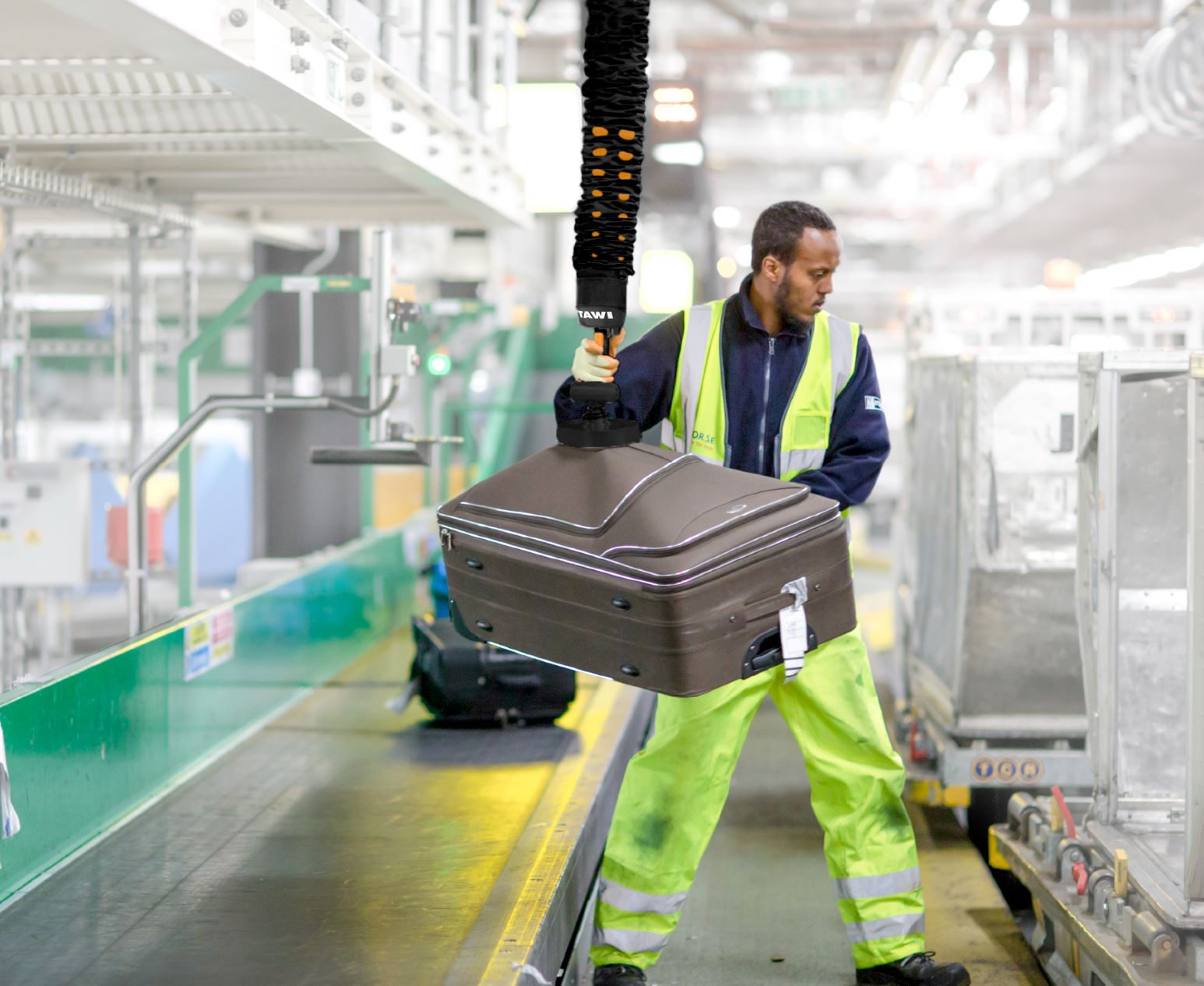
Ground handling operates under aircraft schedule constraints. During aircraft turnarounds, handlers work under time pressure to complete loading within the departure window. Time pressure directly produces postural compromise: handlers prioritise speed over technique, bypassing the repositioning steps that reduce per-lift spinal loading. Engineering controls that remove the vertical load component make it possible to work quickly without compromising safe posture.
The relationship between time pressure and injury risk in baggage handling is documented. Bulduk et al. (2017) found that very high WMSD risk scores in back, shoulder and wrist regions were associated with low and moderate job satisfaction among handlers — a reflection of the psychosocial stress that accompanies physically demanding work under sustained time pressure. Psychosocial stress amplifies the perception of physical demands and has been independently associated with elevated musculoskeletal symptom rates in occupational epidemiology.
The practical consequence is that peak-period handling — when the aircraft turnaround clock is running — is the period of both highest injury risk and greatest operational importance. Administrative controls (rotation, breaks, training) are precisely the measures most likely to be bypassed under peak-period pressure. Engineering controls that reduce per-lift loading without requiring behavioural change are more reliable under these conditions.
Why administrative controls alone cannot manage cumulative exposure
Task rotation, rest breaks, manual handling training, and safe technique instruction all have a legitimate supporting role in MSD prevention. They are not sufficient as standalone measures for high-volume baggage handling operations. The reasons are structural.
Rotation between two high-frequency manual handling tasks does not substantially reduce total spinal loading — it redistributes it between anatomical regions. Only rotation between a manual handling task and a genuinely low-demand task provides meaningful physical recovery time. Under peak-period staffing pressures, this is often not operationally feasible.
Manual handling training produces measurable improvements in technique immediately post-training. Longitudinal studies consistently show these improvements are not sustained at six or twelve months: trained behaviour is displaced by habitual pattern and time pressure. Training changes what handlers know; it does not reliably change what they do when the conveyor is running, and the aircraft is boarding.
The conclusion from the literature is direct: administrative controls support engineering controls, but cannot replace them. For operations managing handlers who lift thousands of bags per shift, every shift, for careers that may span ten to twenty years, the only durable route to managing cumulative MSD exposure is to reduce the per-lift spinal loading through engineering.
NIOSH’s hierarchy of controls reached this conclusion before the airport-specific research confirmed it. The Copenhagen cohort study, the Lu et al. laboratory data, and the operational experience of 650+ TAWI installations across 65+ airports all point in the same direction.
↗ How to prevent work-related injuries in manual handling https://www.tawi.com/lifting-insights/how-to-prevent-work-related-injuries-when-manually-handling-goods