
The NIOSH Lifting Equation Explained: A Practical Guide for Airport Operators
The NIOSH Revised Lifting Equation (RNLE) is the most widely used and validated tool for assessing manual lifting risk in occupational health and safety practice. If you have read any research on baggage handler MSD risk — particularly NIOSH’s own studies of airport screening operations — you will have encountered the Lifting Index (LI) and the back compressive force data that the equation generates. Understanding what these scores mean in practice is essential for conducting your own manual handling risk assessments and making defensible decisions about engineering controls.
This guide explains the RNLE in plain terms, applies it to airport baggage handling tasks with real data, and explains what to do with the results.
What is the NIOSH Revised Lifting Equation?
The NIOSH Revised Lifting Equation calculates a Recommended Weight Limit (RWL) for a given lifting task based on six variables: load weight, horizontal reach distance, vertical lift height, vertical travel distance, trunk rotation and lifting frequency. Dividing the actual load weight by the RWL gives the Lifting Index — the core risk score. A Lifting Index above 1.0 indicates elevated MSD risk.
The equation was developed by Waters, Putz-Anderson, Garg and Fine (Ergonomics, 1993) and has been validated in multiple large epidemiological studies. The six task variables it accounts for are: the weight of the load (W), the horizontal distance from the handler’s lumbar region to the load at the start of the lift (H), the vertical height of the hands at the lift origin (V), the vertical distance the load travels (D), the asymmetry angle — the degree to which the handler twists from the mid-sagittal plane (A) — and the lifting frequency (F). A coupling multiplier accounts for how well the handler can grip the load.
Each variable is expressed as a multiplier that reduces the RWL from its maximum theoretical value of 23kg (51lbs) — the load weight that could be safely lifted under ideal conditions. Real-world task variables always reduce the RWL below this maximum. For most airport baggage handling tasks, the RWL under actual conditions is well below the average bag weight of 14.5kg to 15kg.
What does the Lifting Index score mean?
The Lifting Index is interpreted as follows:
- LI below 1.0: Low risk. The task is within safe limits for most healthy handlers.
- LI between 1.0 and 2.0: Moderate risk. Some handlers will be at risk; controls should be considered.
- LI between 2.0 and 3.0: High risk. Most handlers are at risk; controls are needed.
- LI above 3.0: Very high risk. Engineering controls are required.
NIOSH recommends designing tasks to achieve an LI below 1.0. In baggage handling, this is often not achievable without engineering controls at average bag weights — let alone at the heavier bags in the distribution.
What did NIOSH’s own airport assessments find?
NIOSH researchers applied the RNLE to seven manual lifting tasks performed by four TSOs (Transportation Security Officers) in the T7 baggage screening area at Oklahoma City International Airport (NIOSH EPHB 010-22a, 2014). The ETD table height was 30in (76cm), and the clear conveyor height was 44in (112cm) — a 14-inch (36cm) height difference that handlers must accommodate during each transfer.
Results at a lifting frequency of one per five minutes: for 25lb (11kg) bags, the average LI across seven sampled lifts was 1.1. For 40lb (18kg) bags, the average was 1.7. For 50lb (23kg) bags, the average was 2.2. At a frequency of one lift per minute (representative of rush periods), these averages rose to 1.2, 1.9 and 2.4, respectively. Individual task scores ranged from below 1.0 to above 3.35 — reflecting the substantial variation in specific postures and positions across the seven sampled tasks.
The practical interpretation: at average bag weights and low frequency, CBRA screening tasks fall in the moderate-to-high risk range for most handlers. At higher bag weights or higher frequencies — or both simultaneously — they enter the very high risk range. No administrative control adequately mitigates a very high LI score. Engineering controls are required.
↗ Lifting weight limits at work — what the research says https://www.tawi.com/lifting-insights/lifting-weight-limits-at-work-whats-the-maximum-you-can-lift
What is back compressive force and how does it relate to the Lifting Index?
Back compressive force measures the actual mechanical load on the L4/L5 intervertebral disc during a lift. NIOSH uses the University of Michigan 3DSSPP biomechanical model to calculate it from postural data and force measurements. The NIOSH action limit is 770 lbs (349 kg) of compressive force; forces above this level indicate significant injury risk. The LI provides an estimate of relative risk; compressive force provides the absolute biomechanical measure.
The 3DSSPP programme requires video-captured postural data — 15 body angles including trunk flexion, lateral bending, axial rotation and arm positions — plus the hand forces applied during the task. For the CBRA manual lifting tasks at Oklahoma City, the average compressive force was 716lbs (325kg) for a 50lb bag — approaching but below the 770lbs limit on average, with 43% of individual lifts exceeding it. Some individual measurements reached 857lbs (389kg).
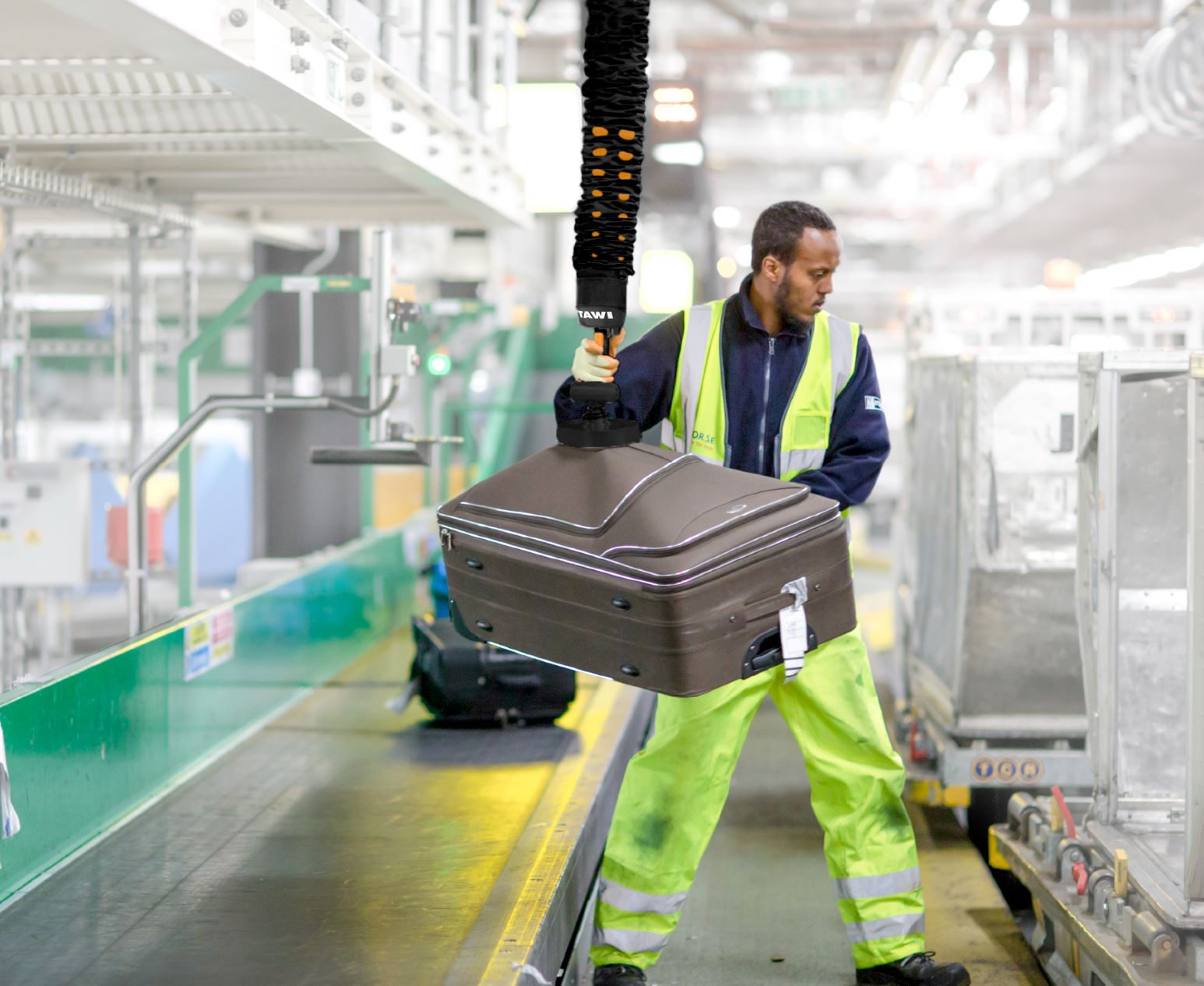
When a vacuum lift system was introduced for the same tasks, the average compressive force dropped to 262lbs (119kg) — a 63% reduction. The improvement has two sources: the vacuum system eliminates the vertical lifting load, and the handler’s posture shifts from a bent-forward lifting stance to a near-upright guiding stance. Both changes reduce the compressive force directly.
What are the limitations of the NIOSH equation?
The RNLE is a well-validated risk estimation tool, not a guarantee of injury prevention. Understanding its limitations helps you use it appropriately. First, it uses standardised anthropometric inputs (typically average US male). It may underestimate risk for shorter handlers or handlers with pre-existing conditions.
Second, it assesses single lifting tasks — it does not model the cumulative loading across an entire shift or a working career. Third, it does not account for combined exposures: a handler who also pushes and pulls baggage carts, drives ground support vehicles and performs other manual tasks faces a higher combined risk than the LI for any single lifting task suggests.
The LI is a relative risk indicator. The compressive force measurement provides the absolute biomechanical metric. For a comprehensive risk assessment of a baggage handling operation, both should be used — the LI to prioritise which tasks need attention, and compressive force modelling to validate the engineering control selection.
Applying the NIOSH framework to your operation
A practical NIOSH-based risk assessment for airport baggage handling follows three steps.
Step 1 — Task mapping: Identify every location in your operation where manual bag lifting occurs: CBRA rooms, make-up area conveyors, ramp AKE positions, check-in, reclaim. For each task, document bag weight range, lift origin and destination heights, horizontal reach distance, frequency during peak and low periods, and degree of trunk rotation involved.
Step 2 — LI calculation: Use the NIOSH RNLE (available free from NIOSH) to calculate the LI for each task, using both average and upper-percentile bag weights. Tasks scoring above 2.0 at average weights, or above 1.0 at upper-range weights, are priority targets for engineering controls.
Step 3 — Intervention selection: For tasks above the action limit, select engineering controls appropriate to the environment. In CBRA rooms, vacuum lift systems — including low-headroom variants for constrained ceiling heights — reduce compressive force by 63%. In ramp and make-up areas, the same technology reduces it by 39% while also delivering throughput improvements.
↗ Manual handling risk assessment and prevention https://www.tawi.com/lifting-insights/hazardous-manual-handling-risk-assessment-and-preventions