


More Space for Housing, Green Areas and Mobility: Study Calls for a Rethink of Parking Space Management
Paderborn/Cologne, 7 July 2026 – The greatest challenge facing urban development in the coming years is the increasing scarcity of space. Creating more room for housing, green infrastructure, public spaces and safe mobility requires a more efficient use of urban land. A new study by Lödige Industries, conducted in collaboration with BABLE Smart Cities and IFH KÖLN, concludes that more efficient parking space management can be a powerful lever to achieve this, without compromising accessibility.
One of the study’s key findings is that the mobility challenge facing many cities is increasingly becoming a question of land use. Every additional green space, pedestrian area, cycle lane, charging infrastructure or other public amenity requires urban space that is already in short supply. According to the study, the long-term success of urban development will depend less on creating additional transport infrastructure and more on using limited urban space more efficiently and in a balanced way. European urban planners surveyed for the study identified parking management as one of the most effective tools for shaping modern cities.
At the same time, it is important to recognise that private cars remain essential for many people. In a representative survey of the German population conducted by IFH KÖLN specifically for this study, 93 percent of respondents stated that good accessibility is a fundamental requirement when visiting city centres. At the same time, 67 percent said that accessing the city centre without a car would be difficult for them.
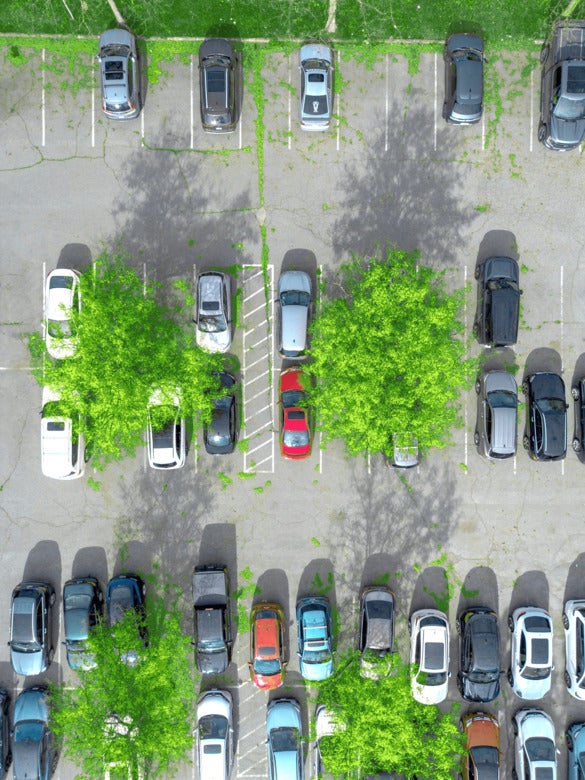
To meet these mobility needs, parking capacity will continue to be required. However, conventional parking occupies a disproportionate amount of valuable urban land. In Berlin alone, publicly available data identifies 1,276,312 on-street parking spaces, covering approximately 14.6 square kilometres of land, an area comparable in size to an entire small town.
“The private car remains an important part of everyday mobility for many people. The challenge is therefore not to restrict mobility, but to organise it more efficiently in terms of land use,” says Dr Markus Preißner, Head of Research at IFH KÖLN. “Cities need solutions that maintain accessibility while simultaneously creating space for other essential urban functions.”
A successful example of combining individual accessibility with attractive public spaces, green areas and high-quality urban environments can be found in the transformation of the former industrial harbour district in Aarhus, Denmark. Around 1,000 parking spaces for the newly developed DOKK1 cultural centre were relocated underground in a space-efficient manner. By storing vehicles compactly in an automated parking system supplied by Lödige Industries, the surface area remains largely free of cars, creating valuable space for public use directly along the waterfront. The company contributes to urban transformation projects around the world by providing highly space-efficient parking solutions that eliminate the need for ramps and drive aisles.
Rather than positioning private vehicles and urban development as opposing objectives, the study concludes that the future success of cities will largely depend on using public space more efficiently and sustainably.
Click here to download the full white paper.