

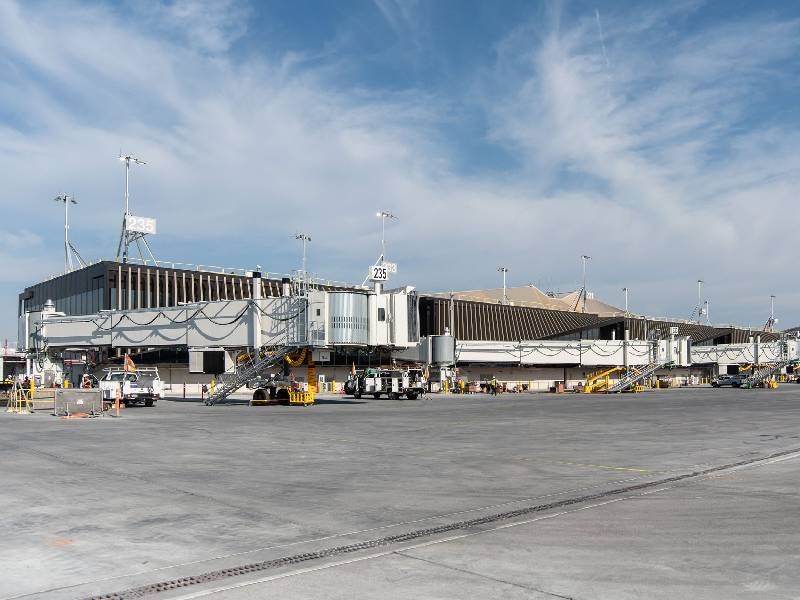

The Midfield Satellite Concourse (MSC) South project at the Tom Bradley International Terminal in Los Angeles World Airport (LAX) was developed to decrease the airport’s dependence on remote gates.
The project provides improved access to concessions, services and lounge areas for passengers
Recommended Buyers Guides

MSC South forms part of a broader phased development plan at LAX being undertaken by the airport authority of Lax, Los Angeles World Airports (LAWA), to modernise and enhance terminal efficiency.
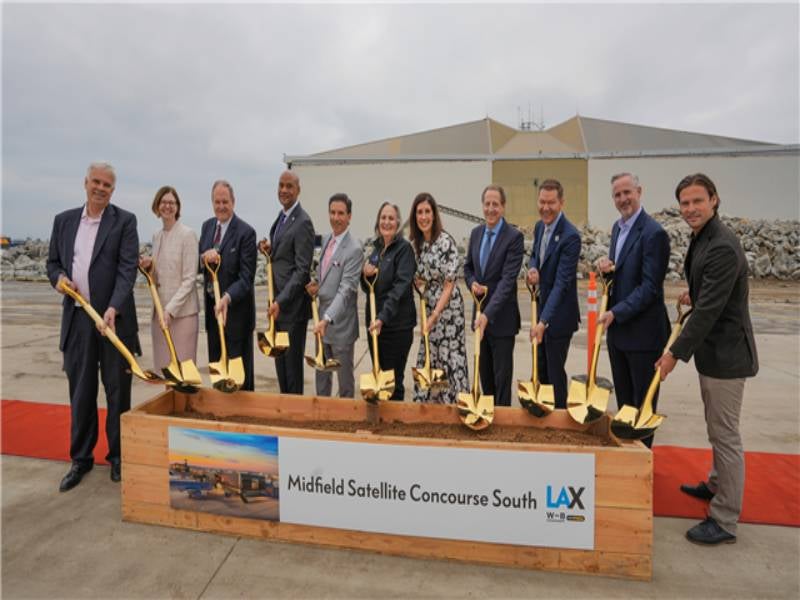
Construction on the project commenced with the ground-breaking in June 2023 and the concourse opened in October 2025.
MSC South design and features
The MSC project extended the West Gates passenger concourse at the Tom Bradley terminal with a 150,000ft² (13,935m²) complex and eight boarding gates designed to accommodate Group III aircraft such as the Boeing 737 and Airbus A320 families.
The two-storey, pre-engineered building features an L-shaped layout that connects directly to the West Gates passenger concourse on the second floor. The design allows for the future addition of three gates.
Facilities include automated boarding gates, interactive video displays and a large video wall in the passenger tunnel.
The concourse also features access control, CCTV, common-use passenger processing, more than 33 new communication rooms, a distributed antenna system, 3,500 network ports, paging systems, telecommunications and Wi-Fi.
The architectural design, inspired by Californian modernist homes, features an angled brise soleil system that reduces sunlight exposure while framing views of the surrounding area. The interior boasts floor-to-ceiling glass windows, enhancing natural light and visibility.
The concourse has been designed with sustainable practices and targets Leadership in Energy and Environmental Design (LEED) Silver certification.
Construction details
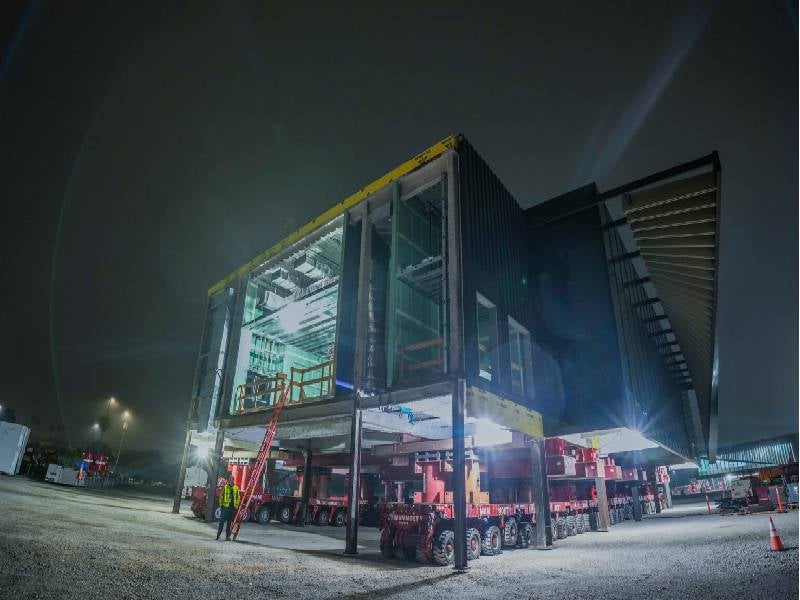
MSC South was constructed using an off-site construction and relocation (OCR) method, an innovative and adaptive technique that saves public funds and time while providing a high degree of building control and supervision.
The OCR technique requires careful consideration of the stresses and loads on segmented structures during transport and installation. Each segment is equipped with its own lateral system to improve seismic resilience.
The concourse was built in nine segments at a location 1.75 miles (2.8km) from the project site and delivered in October 2024 for assembly south of the West Gates passenger concourse.
Each segment, measuring approximately 80ft (24m) × 110ft × 40ft, and weighing up to 1,000 tonnes, was moved every three days, with the entire process completed in around a month.
Large specialist transporters including two self-propelled modular transporters were used to move the segments overnight. The transporters’ wheels could rotate 360°, allowing precise positioning.
The final structural beam was installed in January 2025, seven months after the start of construction.
Contractors involved
Woods Bagot was appointed by LAWA as lead designer for MSC South, working in collaboration with Raw International.
W.E. O’Neil served as general contractor, partnering closely with Woods Bagot and LAWA.
Nevell Group engaged W.E. O’Neil to deliver acoustical ceilings, drywall, fireproofing, insulation, metal framing and plaster, all completed off-site.
Buro Happold acted as structural engineer and provided airport and energy consulting, lighting design and sustainability services.
Civil engineering was delivered by Mott MacDonald/MA Engineering, with Syska Hennessy Group as the mechanical and plumbing engineer, and PBS Engineering as the electrical engineer.
Diaz Yourman & Associates handled geotechnical engineering, while Pfeiler & Associates Engineers carried out site investigations and surveys.
Burns Engineering managed the technology programme, overseeing the design and installation of all technology systems.
SG Engineering Solutions provided project management, commissioning and design review support, while Adept Management was brought in for process mapping and schedule optimisation.
Additional specialist contributors included Hasson Painting Contractors, iFab, Jensen Hughes, PSM Squared, Sankofa Company, Schwab Engineering, Selbert Perkins Design, Swanson Rink, TLC Engineering Solutions and Wolverine Fire Protection.
