
The Northern Runway Project at Gatwick Airport in West Sussex, UK, aims to bring the standby northern runway into regular use to increase the airport’s annual passenger capacity to 80 million.
The £2.2bn ($2.89bn) project is expected to support economic, business and tourism growth in the region.
Recommended Buyers Guides

The airport is owned by VINCI Airports (50.01%) and Global Infrastructure Partners (GIP) (49.99%).
Airport operator Gatwick Airport Limited (GAL) submitted the development consent order (DCO) application for the project to the Planning Inspectorate (PINS) in July 2023, and it was accepted in August.
Following a detailed examination and public consultation, the Secretary of State for Transport approved the project in September 2025.
The Northern Runway Project is scheduled to be operational by 2030, with additional construction continuing until 2038.
The project is fully privately financed, with investment managed through GAL’s Capital Investment Programme.
It is expected to generate an annual economic boost of £1bn ($1.3bn) and create 14,000 new jobs.
Location
Gatwick Airport is situated in West Sussex, between Crawley and Horley, and offers excellent connectivity via the M23 motorway, which passes approximately 1.7km to the east, and the A22 and A24, which both run in a north-south direction, to the west and the east of the airport respectively.
The airport is accessible via the London to Brighton mainline railway, which has a dedicated station at the South Terminal and a direct transit link to the North Terminal.
The Northern Runway Project will be built within Gatwick Airport’s existing 820-hectare (ha) boundary, with 747ha owned by GAL.
Gatwick Airport Northern Runway Project details
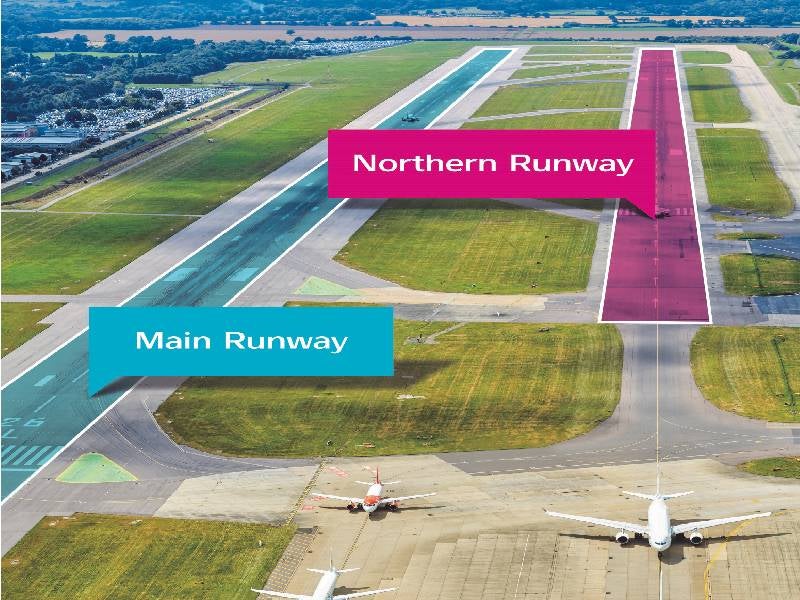
Gatwick Airport currently has two runways. However, only one can be in use at a time due to their proximity.
The main runway is used for regular operations, while the northern runway, designated as a standby, is mainly used for taxiing or when the main runway is unavailable.
The project will include the construction of a 12m-wide strip along the northern side of the northern runway. This adjustment will allow for the repositioning of the runway’s centre line 12m further north, creating a 210m separation between the northern runway and the main runway.
The opening of the new runway will allow all arriving aircraft to use the existing main runway during regular operations. Departures will be shared between the main runway and the northern runway, with controlled coordination between the two runways to ensure safe operations.
Infrastructure upgrades
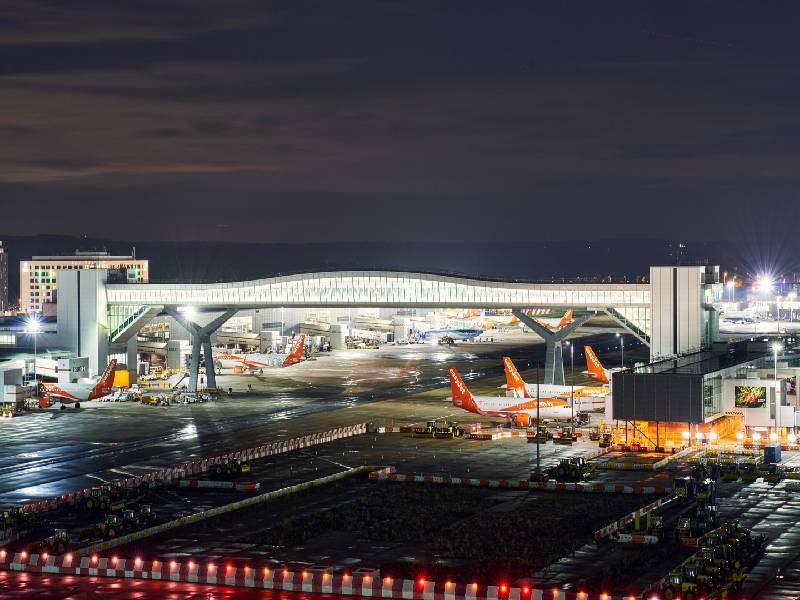
The project will involve the reconfiguration of taxiways and the expansion of North and South terminal buildings. A new pier will be constructed, along with modifications to aircraft stands.
Airport facilities will be developed, including a waste facility, a new hangar and fire training grounds.
The development will also add new office space and hotel rooms, along with an extra 18,500 car parking spaces.
Road improvement works will be carried out, and environmental and mitigation measures will be implemented to ensure sustainable operations.
Contractors involved
Law firm Herbert Smith Freehills Kramer was appointed to provide legal counsel to GAL, assisting with the development consent order (DCO) process and securing approval from the Secretary of State.
Dalcour Maclaren, an environment and planning solutions provider, was contracted to offer land assembly advice, including land referencing and acquisition consultation, ensuring that the project’s land requirements were managed efficiently.
Tetra Tech RPS, a professional services company, provided town planning and environmental consultancy services, preparing the Environmental Statement and Health Impact Assessment for the DCO submission.
Project benefits
The Northern Runway Project will provide benefits such as an increase in overall runway capability from 55 to 69 movements per hour.
It will enhance capacity and recovery during the critical first wave of daily operations and help manage backlogs more effectively.
The project will also have increased capability in the event of disruptions that lead to the closure of the main runway.
By reducing the utilisation of the main runway, the project will alleviate stress on main runway operations.
