
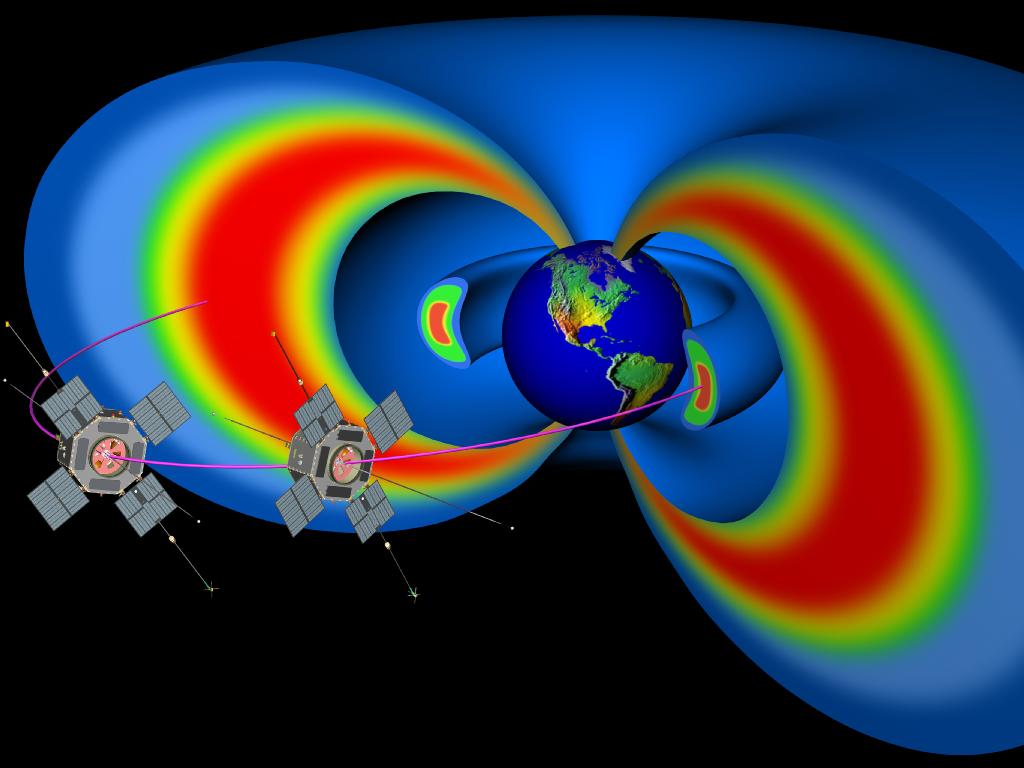
NASA has started final preparations to launch a pair of spacecraft into orbit on 23 August as part of its Radiation Belt Storm Probes (RBSP) mission to study the extremes of space weather.
Commenting on the launch, APL RBSP project manager Richard Fitzgerald said: "Both the twin spacecraft and the entire RBSP team are eager to begin their exploration of one of the most dangerous parts of space near our planet."

Discover B2B Marketing That Performs
Combine business intelligence and editorial excellence to reach engaged professionals across 36 leading media platforms.
Flying aboard United Launch Alliance Atlas V rocket from Cape Canaveral Air Force Station in Florida, US, the $670m worth satellites will collect crucial data of the most hazardous regions in the near-Earth space.
The data will assist researchers in understanding the Van Allen radiation belts, which are the regions of harmful electrons and protons discharged from the sun and trapped by Earth’s magnetic field.
NASA’s heliophysics division director Barbara Giles said: "RBSP will further explore the connection of solar variability and its impacts on Earth’s radiation belts."
The two-year mission will also help scientists understand the behaviour and reaction of the invisible radiation belts to changes in the sun, which will contribute to the understanding Earth’s space weather.
Johns Hopkins University Applied Physics Laboratory (APL) RBSP project scientist Barry Mauk said: "One of the fundamental objectives of the RBSP mission is to use Earth’s magnetosphere as a natural laboratory to understand generally how radiation is created and evolves throughout the universe.
"There are many mysteries that need to be resolved."
According to NASA, space weather fluctuations lead to the increase in radiation exposure for pilots and passengers during polar aircraft flights, as well as disable satellites, cause power grid failures, and disturb the global positioning system, television and telecommunications signals.
Part of NASA’s ‘Living with a Star’ programme managed by Goddard Space Flight Center, the RBSP spacecraft is built and managed by APL.
Image: An Artist’s impression of two spacecraft representing the Radiation Belt Storm Probes, which will study the sun and its effects on Earth. Photo: JHU/APL, NASA.


