
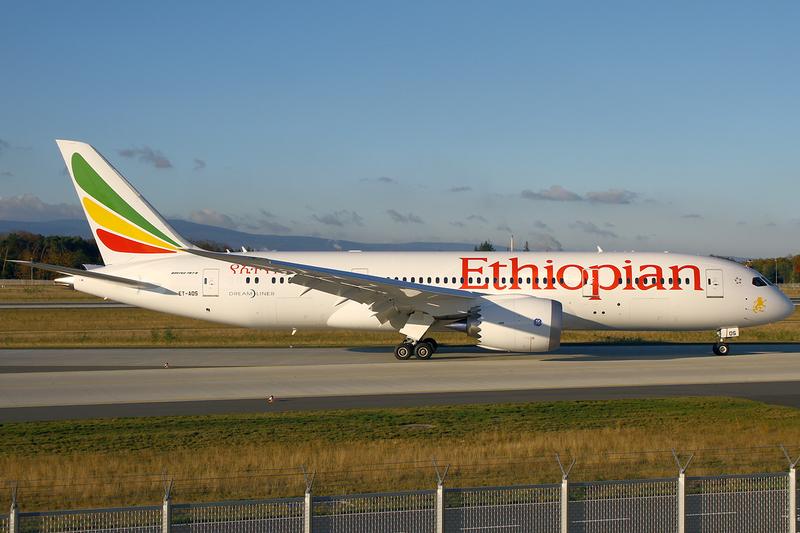
A 787-8 Dreamliner owned by Ethiopian Airlines caught fire while it was parked at London’s Heathrow airport on 12 July.
According to the Air Accidents Investigation Branch (AAIB), smoke was seen throughout the fuselage, with extensive heat damage in the upper portion of the rear fuselage.

Discover B2B Marketing That Performs
Combine business intelligence and editorial excellence to reach engaged professionals across 36 leading media platforms.
The agency said that there was no evidence of the auxiliary power unit (APU) batteries causing the incident.
There was no-one onboard at the time of the incident and there have been no reported injuries.
The AAIB chief has ordered an investigation in order to determine the causal and contributory factors of the incident to prevent a repeat.
The team, which is under supervision of the AAIB, has began a technical investigation into the aircraft, which is currently located in a hangar at London Heathrow, and the initial investigation may take several days.
In a statement, Boeing said that it was working to understand and address the reason behind the incident.
Ethiopian Airlines said that it was still flying its three other 787s while awaiting the results of the investigation.
In addition, other airlines such as United Continental Holdings and All Nippon Airways continued to fly their Dreamliners soon after the fire.
The latest incident comes as a blow for Boeing at a time when it is trying to restore confidence in the wide-body, twin-engine 787, which has experienced a series of delays and mishaps.
The US Federal Aviation Administration (FAA) grounded the entire 787 fleet worldwide on 16 January following a battery fire on a 787 that landed in Boston’s Logan International Airport, as well as another case of an overheated battery, which prompted Japan’s All Nippon Airways’ jetliner to make an emergency landing.
The US regulators cleared the Dreamliner to return to service after Boeing redesigned battery system of the airliner.
The redesign improved insulation of the cells, altering the internal battery components to its lower initiation of a short-circuit within the battery, and a new containment and venting system.
To date, Boeing has delivered a total of 68 Dreamliners to 13 airlines globally.
Image: Ethiopian Airlines stated that it is still flying its three other 787s while awaiting the results of the investigation. Photo: courtesy of Konstantin von Wedelstaedt.



