
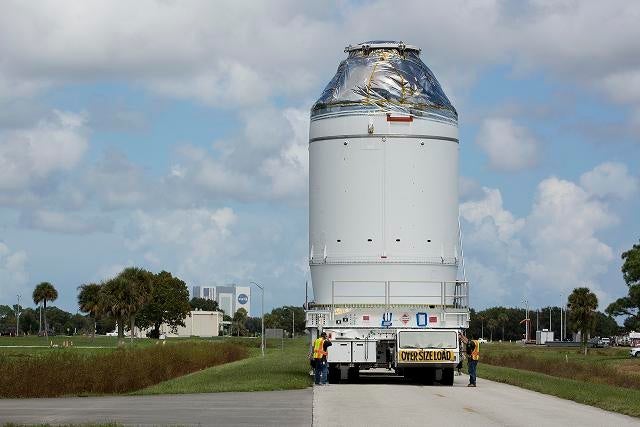
Nasa’s Orion exploration capsule has been moved to the Launch Abort System Facility at Kennedy Space Center, Florida, US, for its integration with the launch abort system (LAS).
The spacecraft was fuelled with ammonia, hydrazine and high-pressure helium at the Payload Hazardous Servicing Facility before it was moved to the LAS.

Discover B2B Marketing That Performs
Combine business intelligence and editorial excellence to reach engaged professionals across 36 leading media platforms.
It marks the final integration stage of Orion prior to the scheduled Exploration Flight Test-1 (EFT-1) in December.
Lockheed Martin Orion programme manager Michael Hawes said: "Once the launch abort system is integrated and functional testing concludes, the spacecraft is considered done.
"Then in November, we’ll integrate to the rocket, which is rolling out to the launch pad today."
Orion’s LAS is a launch safety unit that safeguards the capsule and crew during accidents. It comprises three rocket motors: an attitude control motor, a jettison motor, and an abort motor.
As part of the EFT-1, the spacecraft will be launched aboard United Launch Alliance’s (ULA) Delta IV Heavy rocket, and will travel 3,600 miles into space. It will return to Earth at a speed of more than 20,000 miles per hour.
All the functions, including separation, will be tested on the LAS during the flight; however, abort functions will be inactive as they have been earlier tested during Pad Abort Test 1 at White Sands Missile Range in New Mexico.
Data accumulated will facilitate engineers to validate spacecraft designs.
The three Delta IV Common Booster Cores were integrated at ULA’s horizontal integration facility at Cape Canaveral Air Force Station last week, marking the completion of first stage of the launch vehicle.
The Lockheed Martin-built Orion is part of Nasa’s efforts to fly astronauts beyond low Earth orbit to interplanetary destinations such as asteroids, the moon and Mars, and return them safely back to Earth.
Image: The Orion spacecraft has been transported to the Abort System Facility. Photo: courtesy of Lockheed Martin Corporation.



