
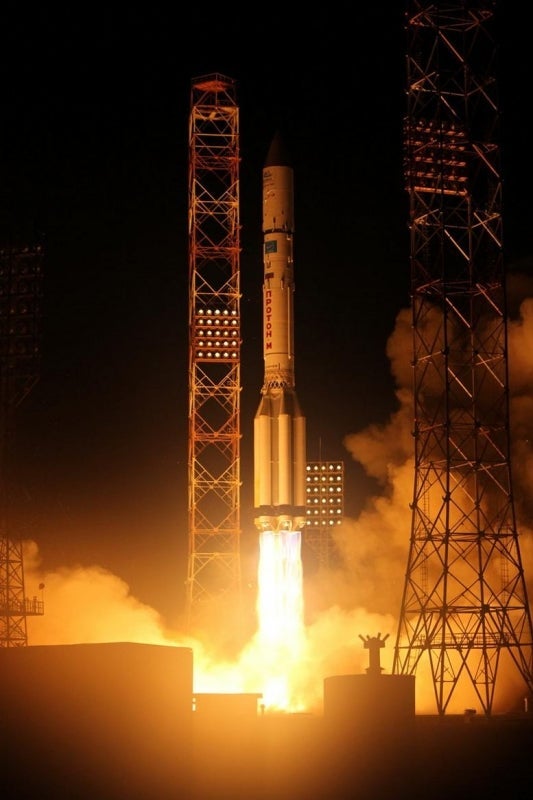
Russian Satellite Communications’ (RSCC) Express-AM7 telecommunications satellite has successfully lifted-off aboard International Launch Services’ Proton-M integrated launch vehicle (ILV) from the Baikonur Cosmodrome in Kazakhstan.
The spacecraft and Breeze-M upper stage separated from the launch vehicle nine hours and 13 minutes after launch.

Discover B2B Marketing That Performs
Combine business intelligence and editorial excellence to reach engaged professionals across 36 leading media platforms.
The Express-AM7 satellite separated from the upper stage and injected to the target orbit. It will be transferred to the geostationary orbit.
Planned to be operated from 40°E orbit slot, the Express-AM7 is designed to provide communications and broadcasting services to Russia, Europe, Sub-Saharan Africa and Southern Asian regions.
Built by Airbus Defence and Space, the satellite is based on Eurostar E3000 platform and has a mass of 5,700kg. It has design lifetime of 15 years.
The Express-AM7 communications payload features 62 active transponders, including 24 in C-band, 36 in Ku-band and two in L-band.
RSCC awarded two contracts to Airbus Defence and Space in March 2012 for Express AM4R and Express-AM7 satellites.
The launch marks Proton’s second launch this year and 403rd in its history.
The heavy-lift vehicle is designed and manufactured by Khrunichev Space Center for transporting government and commercial payloads to low-earth and escape orbits.
Proton-M using Breeze-M as the upper stage is said to deliver more than 6MT payloads to geo-stationary orbits.
Image: Proton-M integrated launch vehicle lift-off Express-??7 telecommunications satellite. Photo: courtesy of Roscosmos.


