
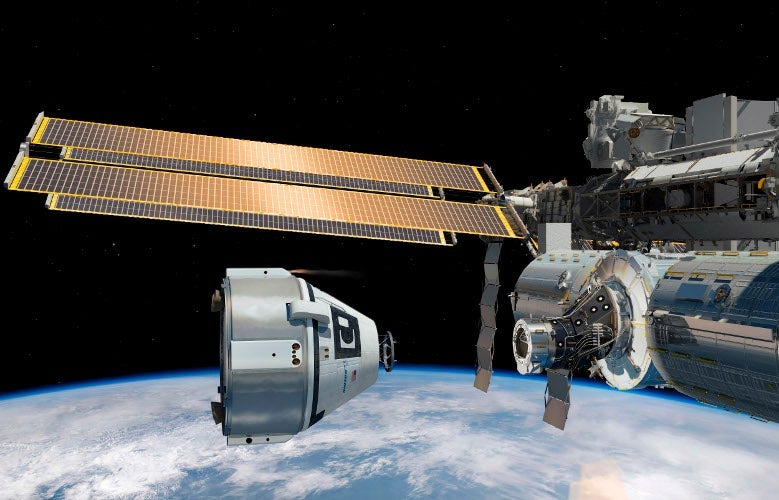
Boeing has secured a first crew rotation mission contract from Nasa to fly astronauts from the US to the international space station (ISS) in 2017.
The contract is said to be the first-of-its-kind by Nasa for a human spaceflight mission with a commercial company.

Discover B2B Marketing That Performs
Combine business intelligence and editorial excellence to reach engaged professionals across 36 leading media platforms.
Boeing space exploration division vice-president and general manager John Elbon said: "We look forward to ushering in a new era in human space exploration."
Nasa’s commercial crew programme is expected to finalise a contract with SpaceX later this year; however, the first company to fly its mission to the station will be decided at a later date.
The agency said in a statement that: "The contract calls for the orders to take place prior to certification to support the lead time necessary for the first mission in late 2017, provided the contractors meet certain readiness conditions."
With Boeing’s Crew Space Transportation (CST) 100 and SpaceX’s Crew Dragon spacecraft, the US will be able to conduct more scientific research aboard the orbiting laboratory.
Last year, Boeing was selected to build a commercial crew transportation system, and the company will also be responsible for at least two and potentially six service flights.
A standard mission to the ISS is expected to carry four crew members and around 220lb of pressurised cargo. During its approximately 210-day stay, the spacecraft will serve as an emergency lifeboat to the station.
CST-100 has been approved to proceed to assembly, integration and test activities after completing the delta integrated critical design review, the fourth milestone in the commercial crew transportation capability (CCtCap) phase of the programme.
The spacecraft is designed to transport up to seven passengers or a mix of crew and cargo to low-Earth orbit.
Boeing commercial programmes vice-president John Mulholland said: "We’re on track to fly in 2017, and this critical milestone moves us another step closer in fully maturing the CST-100 design.
"Our integrated and measured approach to spacecraft design ensures quality performance, technical excellence and early risk mitigation."
Image: Boeing’s Crew Space Transportation 100 spacecraft. Photo: courtesy of Boeing.


