
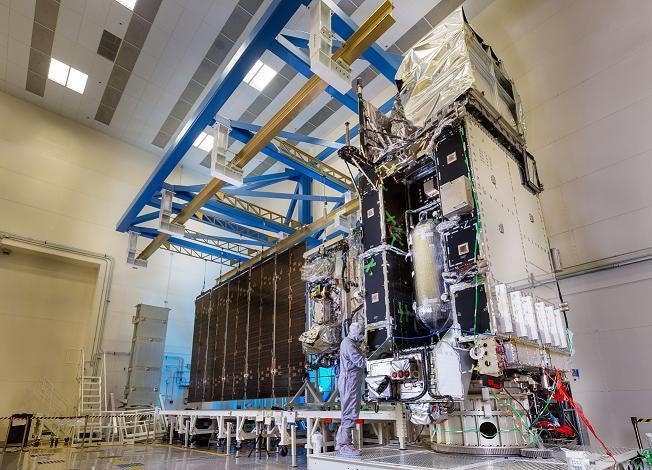
Lockheed Martin has completed assembly of geostationary operational environmental satellite R Series (GOES-R) and is preparing to begin environmental testing.
The National Oceanic and Atmospheric Administration (NOAA) of the US will launch the first of four next-generation geostationary weather satellites in March 2016, aboard an Atlas V from Cape Canaveral Air Force Station, Florida.

Discover B2B Marketing That Performs
Combine business intelligence and editorial excellence to reach engaged professionals across 36 leading media platforms.
GOES-R is designed to enhance the quality of weather data, to monitor conditions over North America through high-resolution images of weather patterns and severe storms.
The spacecraft will also improve hurricane tracking and intensity forecasts, while increasing thunderstorm and tornado warning lead times.
During environmental testing, the satellite and its six instruments will be exposed to launch and the extreme space environment conditions at Lockheed Martin’s facility near Denver, US.
The satellite will complete other tests such as reverberant acoustic, separation and deployment shock, vibration, and electromagnetic interference and compatibility testing.
Lockheed Martin Space Systems vice-president GOES-R Series programme manager Tim Gasparrini said: "NOAA’s GOES satellites are our nation’s weather sentinels and are vital to our severe storm prediction and warnings.
"Now that the first GOES-R Series satellite is complete and environmental testing is underway, we’re one step closer to providing a necessary upgraded capability to NOAA and our nation."
Lockheed Martin was selected by NOAA to build the four GOES-R satellites, as well as the solar ultraviolet imager (SUVI) and the geostationary lightning mapper (GLM) instruments for the spacecraft.
Nasa is responsible for managing acquisition and development of the GOES-R spacecraft and instruments, while NOAA Satellite and Information Service will oversee GOES-R Series operations.
Last month, Harris completed the final two tests on the GOES-R’s ground segment, including 2,100 servers, 149 racks of network equipment, 317 workstations and storage services, totalling three petabytes and 454 blade servers for processing and distributing data.
Image: Engineers and technicians test the deployment of the GOES-R satellite solar array. Photo: courtesy of Lockheed Martin Corporation.


