
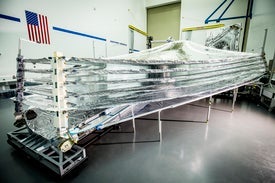
Northrop Grumman has received the first of five sunshield layers that will be installed on Nasa’s James Webb Space Telescope at its facility in Space Park in California, US.
The sunshield layers will help the instrument to image unexplored planets around distant stars and galaxies, created more than 13.5 billion years ago.

Discover B2B Marketing That Performs
Combine business intelligence and editorial excellence to reach engaged professionals across 36 leading media platforms.
Said to be the largest telescope in space, the Webb Telescope is the next-generation space observatory and successor to the Hubble Space Telescope.
The sunshield is constructed with five individual layers of Kapton, which help the unit endure temperature changes between the hot and cold sides of the observatory, and prevent heat from impacting upon the telescope’s infrared sensor.
The tennis court-sized sunshield membranes are designed and manufactured by Alabama-based ManTech International’s subsidiary NeXolve.
Northrop Grumman is responsible to design the optics, sunshield and spacecraft for the Webb Telescope for Nasa’s Goddard Space Flight Center in Maryland.
Northrop Grumman aerospace systems Webb sunshield manager Jim Flynn said: "Through extensive testing we have proven that the innovative sunshield design works.
"We are thrilled to receive the first flight layer from NeXolve as we prepare for 2018 launch."
The Webb Telescope is jointly managed by Nasa, the European Space Agency, and the Canadian Space Agency.
Image: The sunshield of Nasa’s James Webb Space Telescope. Photo: courtesy of Northrop Grumman / Alex Evers.


