
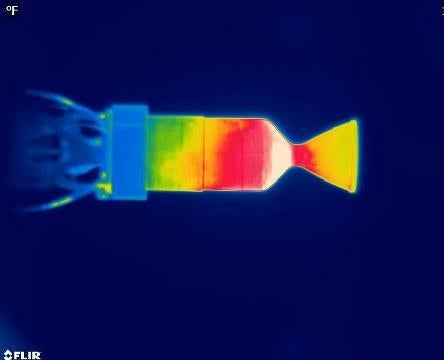
Orbital ATK has completed the first hot-fire test of a 22 Newton (N) thruster using a high-performance green propulsion system.
As part of the trial, the propulsion system used a low-toxicity rocket fuel called LMP-103S, provided by Sweden-based ECAPS.

Discover B2B Marketing That Performs
Combine business intelligence and editorial excellence to reach engaged professionals across 36 leading media platforms.
Green rocket fuels are said to be more cost-effective with respect to storage, material handling, transportation and launch-site processing.
Conducted at Nasa’s Marshall Space Flight Center in Huntsville, Alabama, the test is part of a series of trials intended to evaluate green rocket propellant technologies with the potential to replace hydrazine.
The trial included 5N and 22N thrusters, which performed as expected across all test parameters, Orbital ATK said.
These kind of thrusters are usually used for manoeuvring satellites while in Earth orbit.
Orbital ATK Defense Systems Group missile products division vice-president and general manager Cary Ralston said: "Orbital ATK and our partner ECAPS are dedicated to helping Nasa achieve its goal of eliminating the challenges and risks associated with manufacturing, transporting and handling the current generation of high-performance propellants.
"These successful tests move us another step toward providing safer, higher performance thrusters without the need for expensive and time-consuming protective processes and equipment."
LMP-103S is an environmentally benign propellant offers improved performance, enhanced volumetric efficiency, and helps reduce propellant handling hazards.
Orbital ATK, ECAPS, Nasa Marshall Space Flight Center and Glenn Research Center collaborated to demonstrate the performance and safety features of the green propulsion system for spacecraft systems.
Another nitrate-based propellant called AF-M315E developed by Air Force Research Laboratory was also recently tested with thrusters.
This propellant will be evaluated on a small satellite on Nasa’s Green Propellant Infusion Mission (GPIM).
During the flight, the small-sat will fire thrusters to change the satellite’s altitude and orientation.
Nasa technology demonstration missions at Marshall GPIM mission manager Tim Smith said: "With GPIM’s flight scheduled to launch next year, Nasa and the aerospace industry have taken positive steps to demonstrate use of a propellant that will reduce satellite fueling hazards and save time and money during launch campaigns."
ECAPS focuses on green propulsion-based products for space applications, and has patents worldwide for a family of ammonium dinitramide (ADN) based propellants, catalyst, thruster design and manufacturing methods.
Image: The temperature profile of 22N thruster using the green propellant during pulsing test. Photo: courtesy of Nasa / MSFC / Christopher Burnside.


