
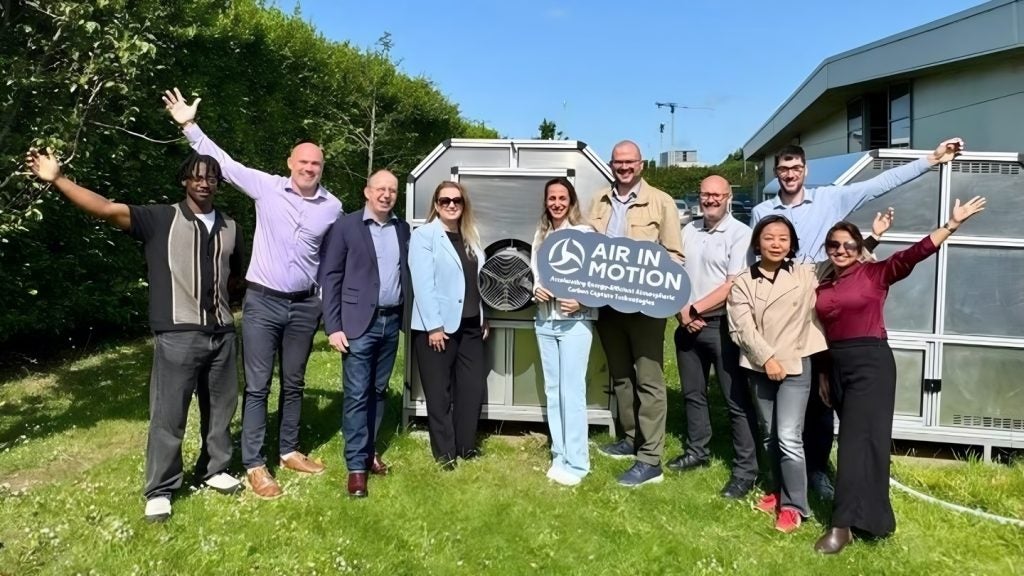
Trinity College Dublin has developed a new carbon capture technology currently undergoing testing at Dublin Airport.
The initiative is funded by a European Innovation Council (EIC) Transition grant called AirInMotion and supported by Enterprise Ireland. It aims to demonstrate the technology's potential in the aviation and e-fuel sectors.
This Direct Air Capture (DAC) technology focuses on scalable, energy-efficient solutions for capturing carbon dioxide from the atmosphere.
It plays a crucial role in reducing industrial emissions and is essential for achieving net-zero targets and combating climate change, according to Trinity.
The technology was created by Professor Wolfgang Schmitt and Dr Sebastien Vaesen from Trinity’s School of Chemistry and the AMBER Centre for Advanced Materials and BioEngineering Research.
For the past three months, the demonstrator has been operational at Dublin Airport, collecting vital data on its efficiency, operational stability, and energy consumption.
The results from this test are expected to validate the technology's performance and guide future development and commercial applications.
Schmitt said: “By advancing and integrating this technology across industries, we are not only reducing emissions but also creating economic opportunities through supplying high-purity CO₂ that aligns with global sustainability goals.”
Dr Elham Katoueizadeh, the project developer, emphasised that after over a decade of research and innovation, the technology is now ready for large-scale implementation across various industries.
Following the initiation of this field test, the team is focused on securing additional investment and forming partnerships to accelerate commercial adoption.
This project aligns with the European Commission's ReFuelEU Aviation legislation, which mandates that sustainable aviation fuel (SAF) must constitute 2% of fuel at EU airports by 2025, increasing to 70% by 2050.
Furthermore, the legislation requires that e-fuels, produced from renewable electricity and sustainable carbon dioxide, account for 50% of SAF.
Andrea Carroll, sustainability director at global airports and travel retail group Daa said: “This project offers Daa an opportunity to explore carbon capture as a potential means of decarbonising our operations and industry.
“The collaboration between Trinity College Dublin and Dublin Airport exemplifies the kind of forward-thinking partnerships that are essential for driving innovation and real change as we all make our way towards a Net Zero world.”