
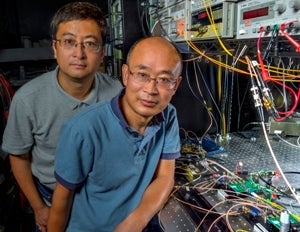
Nasa optical physicist Guan Yang has developed a new laser communication system known as a space optical communication and navigation system.
The new Lasercom matches the agency’s two year old system, which has record-breaking speeds of data download and upload to the moon.

Discover B2B Marketing That Performs
Combine business intelligence and editorial excellence to reach engaged professionals across 36 leading media platforms.
Yang claimed that the new technology also offers highly precise distance and speed measurements in a relatively small package.
In a recent laboratory test, the system showed that it could provide micrometer-level distance and speed measurements over a 622mbps laser communication link.
The breadboard technology consists of commercially available components simulating both ground and space terminals.
Yang said: "Combined with the large communication bandwidth, high-precision ranging over an optical communication network will bring about significant advances in navigation and communications, to say nothing of science gathering, notably in the area of geodesy.

US Tariffs are shifting - will you react or anticipate?
Don’t let policy changes catch you off guard. Stay proactive with real-time data and expert analysis.
By GlobalData"It also will enable use on CubeSats…If you can measure that precisely, you can easily use it for navigation."
Its miniature size will be helpful for use on CubeSats, which is an increasingly popular spacecraft bus that is no larger than a shoebox.
During the space agency’s lunar atmosphere and dust environment explorer (LADEE) demonstration in 2013, the lunar laser communication demonstration (LLCD) experiment downloaded and uploaded test data to and from lunar orbit at 622mbps and 20mbps, respectively.
It proved that it could operate as well as any Nasa radio system.
Mission operators also used LLCD’s lasercom system to download LADEE’s stored science and spacecraft data in just four minutes.
Yang’s new lasercom transceiver was developed by incorporating a Doppler frequency, similar to an ambulance siren that increases or decreases in pitch as the vehicle travels closer or farther away and enabled by a computing algorithm, called the Fast Fourier Transform.
Goddard technology specialising in navigation and communication technologies assistant chief Dennis Woodfork said: "When you’re trying to predict where something is, one of the issues is eliminating measurement errors.
"If errors build too much, you will lose position, and therefore, you won’t know where the spacecraft will be in the future.
"Guan’s measurements are at least an order-of-magnitude better. He got great ranging."
Image: Guan Yang (right) and research associate Wei Lu in front of the lasercom breadboard. Photo: courtesy of Nasa/W. Hrybyk.


