
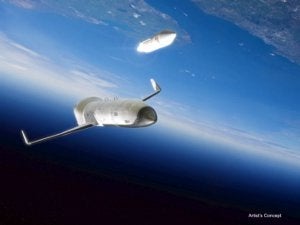
The US Defense Advanced Research Projects Agency (DARPA) has awarded initial design contracts for its next-generation, reusable experimental spaceplane project, called XS-1, as part of efforts to reduce satellite launch costs.
Firms winning DARPA contracts for Phase 1 of XS-1 programme include Boeing, Masten Space Systems and Northrop Grumman, which will work together with Blue Origin, XCOR Aerospace and Virgin Galactic respectively.

Discover B2B Marketing That Performs
Combine business intelligence and editorial excellence to reach engaged professionals across 36 leading media platforms.
DARPA programme manager Jess Sponable said: "We chose performers who could prudently integrate existing and up-and-coming technologies and operations, while making XS-1 as reliable, easy-to-use and cost-effective as possible.
"We’re eager to see how their initial designs envision making spaceflight commonplace, with all the potential military, civilian and commercial benefits that capability would provide."
As part of Phase I of the programme, all involved firms are tasked with designing a reusable first stage launch vehicle that can carry and deploy an upper stage to launch small satellite payloads of 3,000lb to 5,000lb into low-Earth orbit for less than $5m per flight.
Selected companies need to assure that their spaceplanes are capable of flying ten times in ten days; reach speeds of Mach 10 once and launching a representative small payload to orbit faster and more affordably using replaceable upper stages.
US Tariffs are shifting - will you react or anticipate?
Don’t let policy changes catch you off guard. Stay proactive with real-time data and expert analysis.
By GlobalDataPhase I also involves performing critical risk reduction of core component technologies and processes, and build a technology maturation plan for a flight test of XS-1 system capabilities.
DARPA will conduct a Phase II competition in 2015 to validate the work executed during the earlier phase for the follow-on production order to develop the vehicle and conduct demonstration flights, with the spaceplane anticipated to debut as early as 2018.
Boeing XS-1 programme manager Will Hampton said: "Our design would allow the autonomous booster to carry the second stage and payload to high-altitude and deploy them into space.
"The booster would then return to Earth, where it could be quickly prepared for the next flight by applying operation and maintenance principles similar to modern aircraft."
When launched, the first stage of the spaceplane will fly to suborbital space at hypersonic speeds, and then gets back to Earth for reuse, while the upper stage gets separated and deploys the payload into low-Earth orbit.
Image: Flight tests of the experimental spaceplane are scheduled for 2017, with the first orbital mission in 2018. Photo: courtesy of DARPA.



