

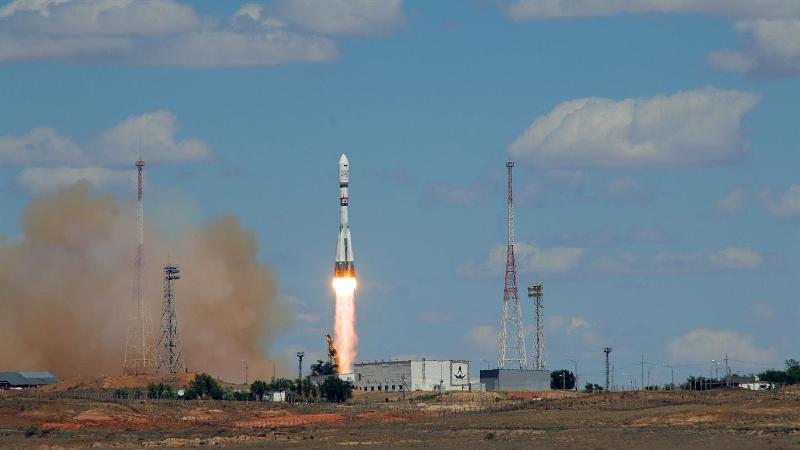
A Russian Soyuz rocket has launched the Flying Laptop and TechnoSat research satellites into space from Baikonur Cosmodrome in Kazakhstan.
Germany's Aerospace Centre’s (DLR) Space Administration and its federal ministry for economic affairs and energy has supported the development, construction and launch of TechnoSat.

Discover B2B Marketing That Performs
Combine business intelligence and editorial excellence to reach engaged professionals across 36 leading media platforms.
DLR has also supported the launch of Flying Laptop.
Both the satellites will be used to test various new technologies under space conditions.
DLR Space Administration department of technology for aerospace systems and robotics programme manager Christian Nitzschke said: “For us, practical training for young engineers is an important aspect of these small satellite missions.
“Another is the chance to test technologies. Many manufacturers, including small and medium-sized enterprises (SMEs), would like to test their aerospace technology and components for future satellites directly in orbit under space conditions.

US Tariffs are shifting - will you react or anticipate?
Don’t let policy changes catch you off guard. Stay proactive with real-time data and expert analysis.
By GlobalData“But up to now, such missions have been very costly. Small satellites could turn things around in this respect.”
Flying Laptop was developed and built by a group of University of Stuttgart students, in partnership with Airbus Defence and Space, and features a system for high-precision attitude control and three solar panels capable of generating around 270W of power.
With around two years of mission life, the 110kg satellite also includes a multi-spectral camera system for Earth observation.
Equipped with automatic identification system (AIS) receivers, provided by the DLR Institute of Space Systems, Flying Laptop is also capable of receiving signals from ships.
TechnoSat is a nanosatellite developed by Technical University of Berlin (TU Berlin), Germany.
Featuring a mission life of around a year, the satellite will test seven experiments in space.
Image: Soyuz lifting off with two small satellites from Baikonur Cosmodrome in Kazakhstan. Photo: courtesy of German Aerospace Center (DLR).


