

An engineering team at Nasa's Marshall Space Flight Centre in Huntsville, Alabama, US, has tested the prototype of its first 3D-printed rocket engine part, which comprises copper alloy and Inconel.
An innovative hybrid manufacturing process called automated blown powder laser deposition has been used to develop the igniter prototype, which underwent low-pressure hot-fire testing for more than 30 times to demonstrate its functionality.

Discover B2B Marketing That Performs
Combine business intelligence and editorial excellence to reach engaged professionals across 36 leading media platforms.
An unnamed commercial vendor has built the igniter, which is employed to initiate an engine’s start sequence.
Nasa Marshall Space Flight Centre engineering directorate director Preston Jones said: “It is a technological achievement to 3D print and test rocket components made with two different alloys.
“This process could reduce future rocket engine costs by up to a third and manufacturing time by 50%.”
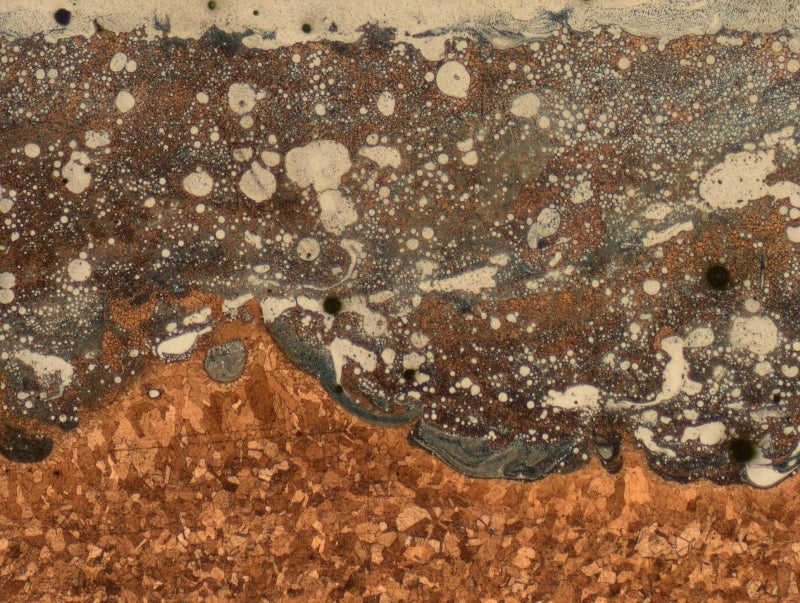
Following the completion of the tests, researchers at the University of Alabama dismantled the igniter prototype to examine images of the bi-metallic interface through a microscope.

US Tariffs are shifting - will you react or anticipate?
Don’t let policy changes catch you off guard. Stay proactive with real-time data and expert analysis.
By GlobalDataThe researchers found that the two metals had inter-diffused, which helps to create a strong bond.
Nasa Marshall Space Flight Centre Materials and Processes Laboratory advanced manufacturing chief and the project lead Majid Babai said: “Eliminating the brazing process and having bi-metallic parts built in a single machine not only decreases cost and manufacturing time, but it also decreases risk by increasing reliability.
“By diffusing the two materials together through this process, a bond is generated internally with the two materials and any hard transition is eliminated that could cause the component to crack under the enormous forces and temperature gradient of space travel.”
According to Nasa, larger igniter, which is typically measured at 10in-tall and 10in-wide, can be made using the automated blown powder laser deposition technology.
Image: An image from a microscope reveals how the two metals, copper alloy and Inconel, mix and interlock to form a strong bond created by the innovative 3D printing process during manufacturing of the igniter prototype. Photo: courtesy of Nasa.


