
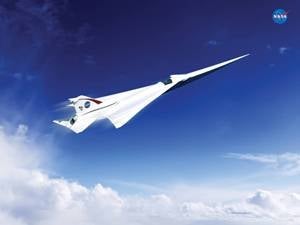
Nasa has selected a team led by Lockheed Martin Aeronautics Company to develop a preliminary design for a low boom flight demonstration (LBFD) quiet supersonic transport (QueSST) X-plane.
The aircraft is the first in a series of Nasa’s ten-year New Aviation Horizons initiative, mentioned in its 2017 fiscal budget.

Discover B2B Marketing That Performs
Combine business intelligence and editorial excellence to reach engaged professionals across 36 leading media platforms.
Under the Basic and Applied Aerospace Research and Technology (BAART) contract at Nasa’s Langley Research Center in Hampton, Virginia, US, Lockheed will perform the work.
Nasa administrator Charles Bolden said: "Nasa is working hard to make flight greener, safer and quieter, all while developing aircraft that travel faster, and building an aviation system that operates more efficiently.
"To that end, it’s worth noting that it’s been almost 70 years since Chuck Yeager broke the sound barrier in the Bell X-1 as part of our predecessor agency’s high-speed research.
"Now we’re continuing that supersonic X-plane legacy with this preliminary design award for a quieter supersonic jet with an aim toward passenger flight."
US Tariffs are shifting - will you react or anticipate?
Don’t let policy changes catch you off guard. Stay proactive with real-time data and expert analysis.
By GlobalDataTo build the quieter supersonic passenger jet, Nasa’s commercial supersonic technology project asked industry leaders to design ideas for a piloted test aircraft, which is capable to fly at supersonic speeds, creating a supersonic ‘heartbeat’ against the current noisy sound made by supersonic flight.
Nasa aeronautics research mission associate administrator Jaiwon Shin said: "Developing, building and flight testing a quiet supersonic X-plane is the next logical step in our path to enabling the industry’s decision to open supersonic travel for the flying public."
Including subcontractors GE Aviation of Cincinnati and Tri Models, the Lockheed Martin team will be provided around $20m over 17 months to conduct preliminary design work for QueSST.
As part of the project, the selected company will develop baseline aircraft requirements and a preliminary aircraft design with specifications, as well as provide related documentation for concept formulation and planning.
The documentation will be used to prepare for the detailed designing, building and testing of the QueSST jet, with planning to undertake analytical and wind tunnel validation of the preliminary design.
As part of this LBFD phase of the project, validation of community response to the new, quieter supersonic design will also be carried out.
Nasa’s aeronautics research mission directorate’s integrated aviation systems program will prepare the detailed design and build the QueSST aircraft in future.
Depending upon funding, the agency is planning to begin a flight campaign for the aircraft by around 2020.
Image: An artist’s concept of a possible low boom flight demonstration quiet supersonic transport (QueSST) X-plane design. Photo: courtesy of Lockheed Martin.


