
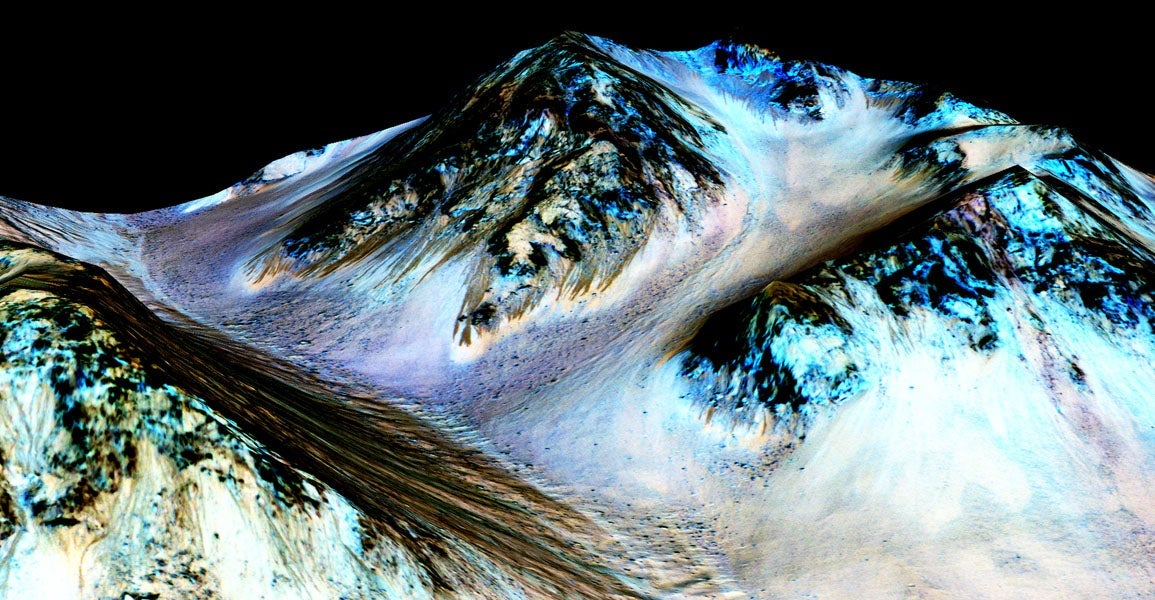
US space agency Nasa confirmed that it has found strong evidence of flowing of liquid water on Mars, suggesting the possibility of life on the planet.
Nasa’s Mars Reconnaissance Orbiter (MRO), which has been circling the planet since 2006, provided evidence that liquid water occasionally flows on Mars.

Discover B2B Marketing That Performs
Combine business intelligence and editorial excellence to reach engaged professionals across 36 leading media platforms.
Researchers used an imaging spectrometer on MRO that detected marks of hydrated minerals on the planet’s slopes where mysterious streaks can be seen.
The streaks appear to recede and flow over time; they darken and seem to flow during warm seasons and fade in cooler conditions.
These indications emerge in several locations on Mars when temperatures are above -23°C.
Nasa Washington Science Mission Directorate’s astronaut and associate administrator John Grunsfeld said: "Our quest on Mars has been to ‘follow the water,’ in our search for life in the universe, and now we have convincing science that validates what we’ve long suspected.

US Tariffs are shifting - will you react or anticipate?
Don’t let policy changes catch you off guard. Stay proactive with real-time data and expert analysis.
By GlobalData"This is a significant development, as it appears to confirm that water, albeit briny, is flowing today on the surface of Mars."
Nasa’s Phoenix spacecraft landed on Mars in 2008 and confirmed the long-suspected presence of ice in the soil.
The downhill flows, known as recurring slope lineae (RSL), appear to bear a similarity to liquid water.
Now, the new findings of hydrated salts on the slopes are what researchers are calling the strongest evidence of liquid water on the planet.
Hydrated salts lower the freezing point of liquid brine and scientists describe the new finding as a shallow subsurface flow.
Georgia Institute of Technology, Atlanta, Lujendra Ojha said: "We found the hydrated salts only when the seasonal features were widest, which suggests that either the dark streaks themselves or a process that forms them is the source of the hydration.
"In either case, the detection of hydrated salts on these slopes means that water plays a vital role in the formation of these streaks,"
Lujendra Ojha is the lead author of a report on these findings published in this week by Nature Geoscience.
Image: Dark streaks on the Hale Crater of Mars that suggest seasonal flow of water. Photo: courtesy of Nasa/JPL-Caltech/Univ. of Arizona.


