
The Earth Science Technology office (ESTO), part of Nasa’s Earth science division, has selected four new projects to be developed, built, and launched into low-Earth orbit to test new technologies before launching future Earth observation missions.
The new technologies could provide an improved understanding of the planet.

Discover B2B Marketing That Performs
Combine business intelligence and editorial excellence to reach engaged professionals across 36 leading media platforms.
Under the projects, Nasa plans to develop, build and launch CubeSats, each measuring 10 x 20 x 30cm.
The development of CubeSat Radiometer Radio Frequency Interference Technology Validation (CubeRRT) project will be led by Ohio State University in the US.
The CubeRRT project will be designed to observe, detect and mitigate radio frequency interference (RFI) for microwave radiometers, an instrument that measures the Earth’s properties such as atmospheric water vapour or soil moisture.
The Compact Infrared Radiometer in Space (CIRiS) project will be led by Ball Aerospace & Technologies and will use an existing instrument to ensure it is CubeSat compatible in order to validate instrument performance in low-Earth orbit. The mission will also validate data processing algorithms and on-orbit instrument calibration.
US Tariffs are shifting - will you react or anticipate?
Don’t let policy changes catch you off guard. Stay proactive with real-time data and expert analysis.
By GlobalDataNasa’s Jet Propulsion Laboratory will lead the CubeSat Infrared Atmospheric Sounder (CIRAS) project.
This project seeks to develop a CubeSat-size instrument system that can match temperature and water vapour profile measurements in the lower troposphere of the Atmospheric Infrared Sounder (AIRS) instrument on the space agency’s Aqua satellite and the Cross Track Infrared Sounder (CrIS) instrument on the Nasa / NOAA joint polar satellite system.
In the future, constellations of CIRAS satellites are expected to improve the timeliness and resolution of critical infrared sounding data, weather forecasting and help research severe weather and climate.
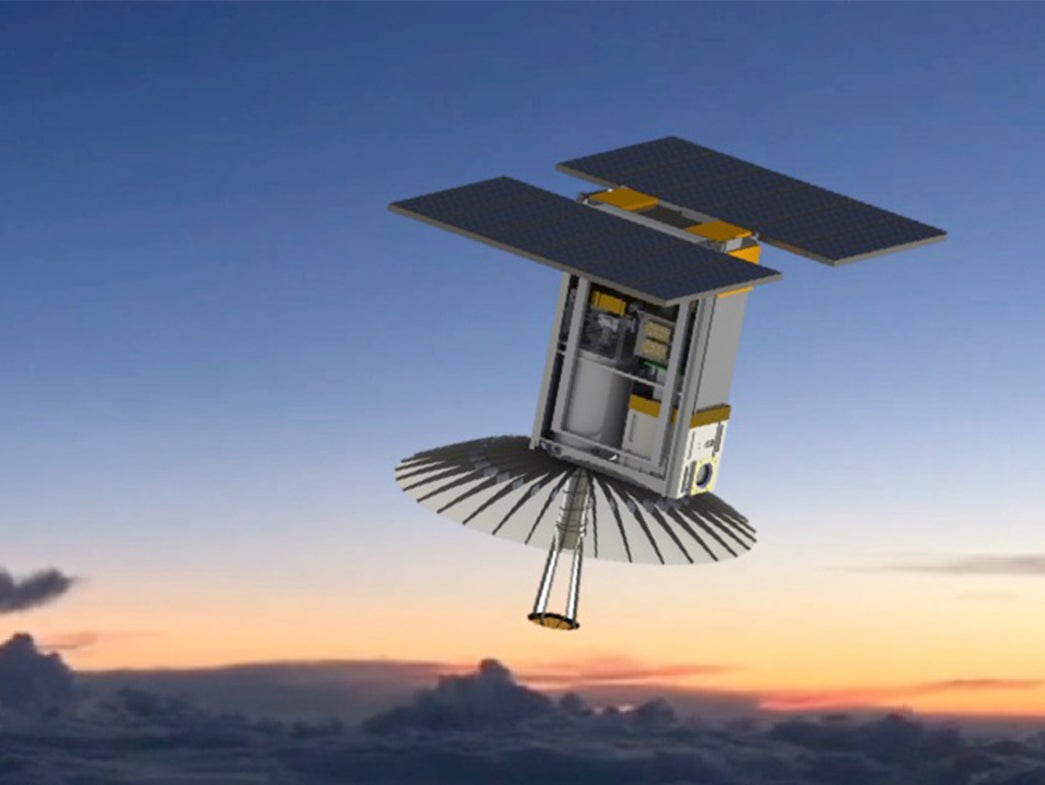
The last project selected is Precipitation Profiling Radar in a CubeSat (RainCube), which will be the first active radar on a CubeSat platform and will be guided by the Jet Propulsion Laboratory.
A constellation of RainCube satellites is expected to provide temporal resolution for weather observations, which can be used to improve forecasting models.
After validation, the projects will have the ability to improve Earth science observations and researchers worldwide will be able to cover various topics, including weather, climate, soil moisture and land use.
Image: An illustration of RainCube. Photo: courtesy of RainCube team.


