
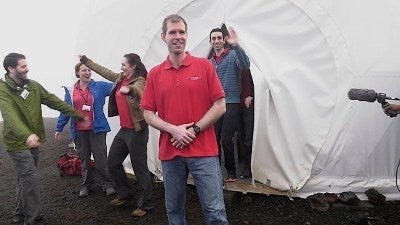
A group of six crew members has left their Mars simulation habitat located on Mauna Loa, Hawaii, US, where they have lived in near isolation for a year.
During their stay in the mountain, located around 8,200ft above sea level, the crew lived in a geodesic dome set in a Mars-like environment.

Discover B2B Marketing That Performs
Combine business intelligence and editorial excellence to reach engaged professionals across 36 leading media platforms.
The Nasa-funded project, Hawaii Space Exploration Analog and Simulation (HI-SEAS) has been run by the University of Hawaii at Manoa (UH).
It was UH’s fourth HI-SEAS project, with which Nasa intends to understand how teams of astronauts will perform on long-duration space exploration missions, including those required for human travel to Mars.
HI-SEAS’ principal investigator and University of Hawaii Manoa professor Kim Binsted said: “HI-SEAS is an example of international collaborative research hosted and run by the University of Hawaii."
Last year, Nasa awarded a third grant to HI-SEAS to keep the research project and its missions funded through 2019.

US Tariffs are shifting - will you react or anticipate?
Don’t let policy changes catch you off guard. Stay proactive with real-time data and expert analysis.
By GlobalDataThe research will also help researchers to propose strategies for crew composition for deep space missions and help determine the best ways to support such crews while they are working in space.
French HI-SEAS crewmember Cyprien Verseux said: “I can give you my personal impression, which is that a mission to Mars in the close future is realistic.
“I think the technological and psychological obstacles can be overcome.”
UH’s Binsted has already started recruiting for the next two HI-SEAS missions scheduled to begin next year and 2018 respectively.
Image: HI-SEAS crewmembers exited their Mars simulation habitat. Photo: courtesy of University of Hawaii System News.


