
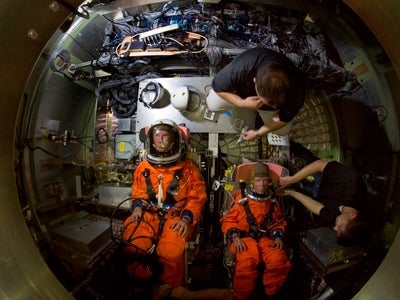
Engineers at Nasa’s Langley Research Center in Hampton, Virginia, US, have completed a series of four vertical drop tests with Orion test capsule, as part of the agency’s next-generation Orion spacecraft for future deep space missions.
During the latest drop test, two crash-test dummies wearing modified advanced crew escape system suits were secured in the full-scale Orion capsule.

Discover B2B Marketing That Performs
Combine business intelligence and editorial excellence to reach engaged professionals across 36 leading media platforms.
Each dummy was equipped with internal sensors to assist engineers to quantify the potential for injury to be experienced by the crews when Orion re-enters Earth’s atmosphere.
After securing the dummies inside the test capsule, Nasa engineers drop the capsule into Langley Research Center’s 20ft-deep hydro impact basin to simulate the possible experience when the spacecraft will splash down in the Pacific Ocean after deep-space missions.
Nasa said that while making an re-entry, Orion will descend under its three main parachutes, swaying in the wind until its final splashdown in the Pacific Ocean.
The moment when the capsule meets water, astronauts will experience some of the greatest forces on the human body, and the recent crash-test dummies test was conducted to evaluate the situation.
US Tariffs are shifting - will you react or anticipate?
Don’t let policy changes catch you off guard. Stay proactive with real-time data and expert analysis.
By GlobalDataThe drop tests account for the diversity of wind and wave conditions that could exist when returning humans from deep-space missions.
Orion prime contractor Lockheed Martin’s crew injury lead Mark Baldwin said: "This gives us a better understanding of localised responses at the head and neck to protect against common impact injuries like concussion and spinal fracture."
"We are intentionally going to extremes in this test series because that is where we need to demonstrate we can keep the structure intact and the crew safe, regardless of the conditions at splashdown."
After completing the four vertical drop tests, Nasa engineers are planning to conduct more rigorous tests during five swing tests of the capsule with the fully suited dummies over the the next few months.
Data from each test are expected to help Nasa prepare for Orion’s first flight aboard a Space Launch System rocket, and eventually provide a safe return journey from Mars.
Image: Crash-test dummies were installed into the crew seats of an Orion test capsule before the drop test. Photo: courtesy of Nasa/David C. Bowman.


