

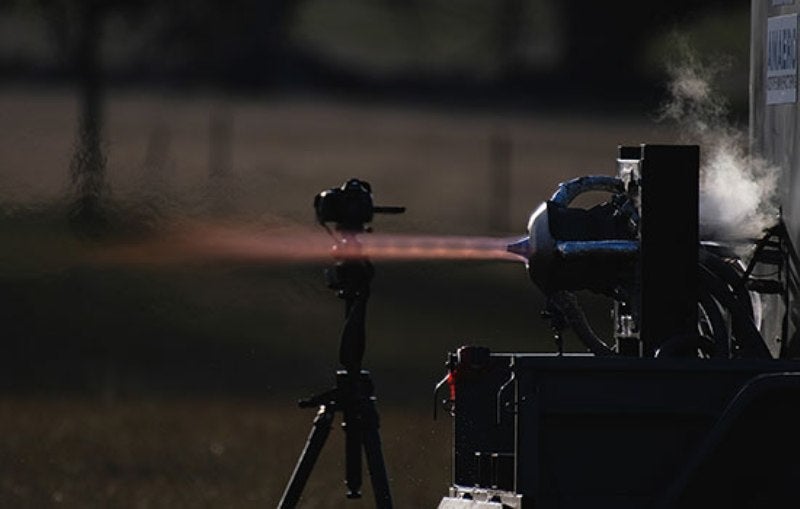
Australia’s Monash University and its spin-out entity Amaero have successfully test-fired a 3D-printed rocket engine.
Designed and tested by Monash University engineers, the new engine features a multi-chamber aerospike design, which reverses the structure of traditional rocket engines.

Discover B2B Marketing That Performs
Combine business intelligence and editorial excellence to reach engaged professionals across 36 leading media platforms.
Engine development has been completed within a four-month period and follows the production of a 3D-printed jet engine by Monash University researchers and their partners in 2015.
Amaero engineer Marten Jurg said: “Traditional bell-shaped rockets, as seen on the Space Shuttle, work at peak efficiency at ground level.
“As they climb the flame spreads out reducing thrust. The aerospike design maintains its efficiency but is very hard to build using traditional technology.
“Using additive manufacturing, we can create complex designs, print them, test them, tweak them and reprint them in days instead of months.”

US Tariffs are shifting - will you react or anticipate?
Don’t let policy changes catch you off guard. Stay proactive with real-time data and expert analysis.
By GlobalDataMonash University engineers have already created a new venture, NextAero, to bring their concepts to the global aerospace industry.
NextAero project lead Graham Bell said: “Designing for additive manufacture opens up a raft of possibilities.
“We were able to focus on the features that boost the engine’s performance, including the nozzle geometry and the embedded cooling network.
“These are normally balanced against the need to consider how on earth someone is going to manufacture such a complex piece of equipment. Not so with additive manufacturing.”
Through its Woodside Innovation Centre at Monash University, Woodside Energy has also supported the development of the new aerospike engine.
Image: 3D-printed rocket developed by Monash University and Amaero. Photo: courtesy of Monash University.


