
Lockheed Martin has received the first of five instruments for Nasa’s Origins Spectral Interpretation Resource Identification Security Regolith Explorer (OSIRIS-Rex) spacecraft.
The company is building the spacecraft at its facility near Denver in the US.

Discover B2B Marketing That Performs
Combine business intelligence and editorial excellence to reach engaged professionals across 36 leading media platforms.
OSIRIS-Rex is designed to bring samples of the Bennu asteroid to Earth to help scientists study the composition of material from the earliest part of the solar system’s history. It will also provide information about the source of organic materials and water on Earth.
Nasa Goddard Space Flight Center OSIRIS-Rex project manager Mike Donnelly said: "The next few months will be very busy as we begin integrating the instruments and prepare for the system-level environmental testing programme to begin."
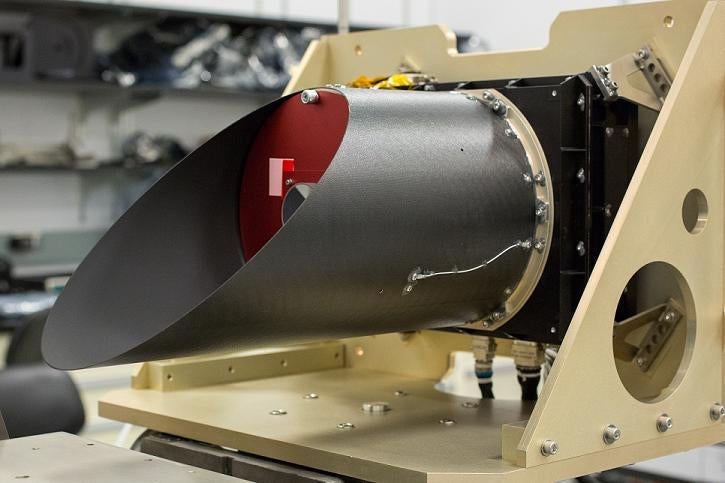
Lockheed Martin will soon install the OSIRIS-Rex Thermal Emission Spectrometer (OTES) instrument onto the spacecraft.
OTES, built at the Arizona State University (ASU) Tempe campus, will evaluate the asteroid’s temperature and conduct surveys to map mineral and chemical abundances.
US Tariffs are shifting - will you react or anticipate?
Don’t let policy changes catch you off guard. Stay proactive with real-time data and expert analysis.
By GlobalDataASU OTES instrument scientist Philip Christensen said: "OTES, the size of a microwave oven, has spent the last several years being designed, built, tested, and calibrated.
"Now, OTES is shipping out for the solar system."
This instrument will come online after the OSIRIS-REx spacecraft starts its two-year trip to Bennu, to provide spectral data for global maps to assess potential sample sites.
OTES is designed to gather thermal infrared spectral data every two seconds, and to detect temperatures with an accuracy of 0.2°F.
Planned for launch in September 2016, the spacecraft is expected to reach Bennu in 2018 and return a sample to Earth in 2023.
Image: The OSIRIS-REx Thermal Emission Spectrometer (OTES) at Arizona State University. Photo: courtesy of ASU / Charles Leight.


