

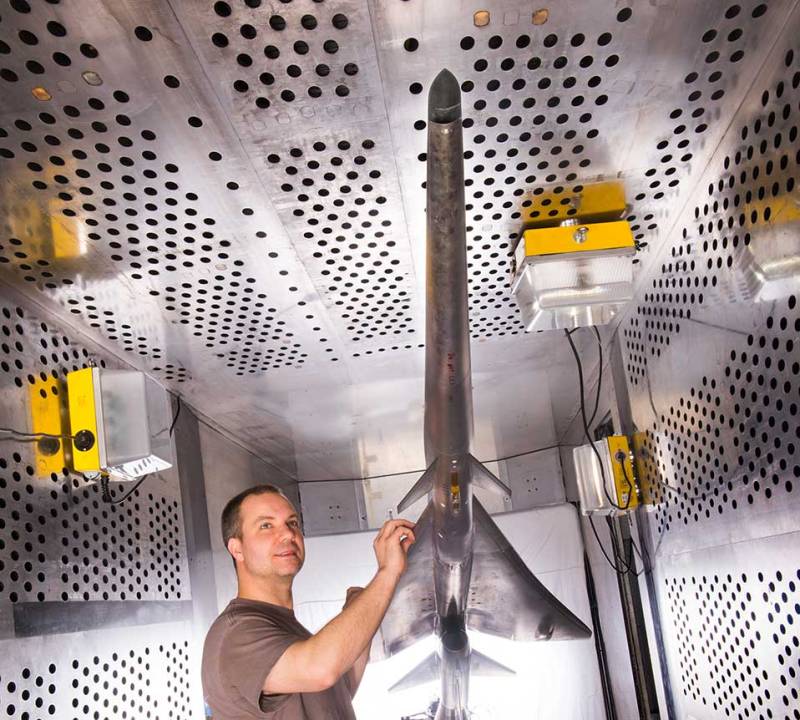
Lockheed Martin has started the high-speed wind tunnel tests for its Quiet Supersonic Technology (QueSST) X-plane's preliminary design, in partnership with Nasa at the space agency's Glenn Research Centre in Cleveland, US.
Nasa will test a 9% scale model of X-plane design in Glenn’s 8ftx6ft supersonic wind tunnel as part of the eight-week testing period. The scale model was developed by Lockheed Martin.

Discover B2B Marketing That Performs
Combine business intelligence and editorial excellence to reach engaged professionals across 36 leading media platforms.
Engineers at Nasa will also expose the plane model to wind speeds ranging from around 150mph to 950mph in order to understand the aerodynamics of the X-plane design, as well as aspects of the propulsion system.
Lockheed Martin has developed the X-plane design as part of a contract awarded by Nasa in February last year.
Nasa QueSST programme propulsion testing leader Ray Castner said: “We’ll be measuring the lift, drag and side forces on the model at different angles to verify that it performs as expected.
“We also want make sure the air flows smoothly into the engine under all operating conditions.”
US Tariffs are shifting - will you react or anticipate?
Don’t let policy changes catch you off guard. Stay proactive with real-time data and expert analysis.
By GlobalDataThe QueSST design is part of a series of X-planes envisioned in Nasa's New Aviation Horizons (NAH) initiative, which seeks to reduce fuel consumption, emissions and noise through innovations in aircraft design that is different from the conventional tube-and-wing aircraft shape.
Lockheed Martin Skunk Works QueSST programme manager Peter Iosifidis said: “Our unique aircraft design is shaped to separate the shocks and expansions associated with supersonic flight, dramatically reducing the aircraft’s loudness.
“Our design reduces the airplane’s noise signature to more of a ‘heartbeat’ instead of the traditional sonic boom that’s associated with current supersonic aircraft in flight today.”
Nasa is planning to begin the flight campaign of the QueSST X-plane by 2020.
Image: Mechanical technician Dan Pitts prepares the model for wind tunnel testing. Photo: courtesy of NASA.


