
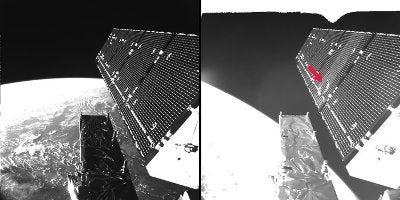
The European Space Agency’s (ESA) Sentinel-1A satellite has been hit by a small particle in orbit, denting one of its solar panels.
The agency is yet to identify the particle that hit the Sentinel-1A, but suspects it to be a piece of space debris. However, the speculation of being hit by a micrometeoroid has also been raised.

Discover B2B Marketing That Performs
Combine business intelligence and editorial excellence to reach engaged professionals across 36 leading media platforms.
Despite being struck by a particle, Sentinel-1A is now operating normally.
ESA Germany space debris office head Holger Krag said: “Such hits, caused by particles of millimetre size, are not unexpected.
“These very small objects are not trackable from the ground, because only objects greater than about 5cm can usually be tracked and, thus, avoided by manoeuvring the satellites.
“In this case, assuming the change in attitude and the orbit of the satellite at impact, the typical speed of such a fragment, plus additional parameters, our first estimates indicate that the size of the particle was of a few millimetres.”
Following the incident, the ESA said that it had noticed little power reduction in a solar array of Sentinel-1A, which is currently orbiting at an altitude of 700km above the Earth.
Minor changes in the orientation and the orbit of the satellite were also measured simultaneously.
Krag added: “In this case, assuming the change in attitude and the orbit of the satellite at impact, the typical speed of such a fragment, plus additional parameters, our first estimates indicate that the size of the particle was of a few millimetres.
“Analysis continues to obtain indications on whether the origin of the object was natural or man-made. The pictures of the affected area show a diameter of roughly 40cm created on the solar array structure, confirming an impact from the back side, as suggested by the satellite’s attitude rate readings.”
Part of European Union’s Copernicus programme, the Sentinel-1 satellites are currently being operated by ESA.
Image: Before and after images of fragment impact in space. Photo: courtesy of European Space Agency.


