
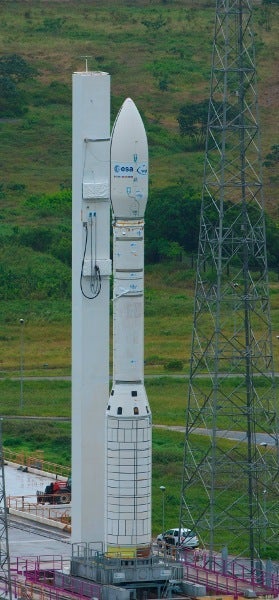
The European Space Agency (ESA) is planning to launch its new Vega rocket on 9 February 2012 from the Guiana Space Centre (GSC) in Kourou, French Guiana.
The 30m-high rocket has been developed to lift payloads of up to 1.5t into a polar orbit. Vega’s first three segments burn a solid fuel and its fourth and final stage use liquid propellants, and can be stopped and restarted several times to propel the spacecraft into the correct orbit. The second stage and third stage, called Zefiro 23 and Zefiro 9 respectively, use solid propellant motors, while the first stage uses bi-propellant liquid upper stage, or AVUM (Attitude and Vernier Upper Module).

Discover B2B Marketing That Performs
Combine business intelligence and editorial excellence to reach engaged professionals across 36 leading media platforms.
The rocket will carry the Laser Relativity Satellite (LARES) developed by Italy’s ASI space agency, along with several micro-satellites. LARES has completed initial fit checks with the payload adapter and fairing that encloses six to nine small CubeSats and the ALMASat-1 designed by European universities.
ESA is planning to launch an operational Vega about twice a year which will carry small scientific and government satellites. Vega was initially scheduled for launch in 2009 and in October ESA set a 30 January date for the light rocket’s first voyage. The launch will demonstrate ESA’s three-pronged launch capability.
Currently, ESA can lift a 20t automated transfer vehicle (ATV) supply module through its heavy-lifter Ariane ES to the International Space Station, while its Ariane ECA can lift communications satellites of up to 10t into geostationary orbit. ESA is planning to launch its IXV (Intermediate eXperimental Vehicle) on the Vega launcher in 2014.
It is also studying a plan to launch the LISA Pathfinder scientific satellite on a Vega launcher from the Verta batch between October 2013 and September 2014.

US Tariffs are shifting - will you react or anticipate?
Don’t let policy changes catch you off guard. Stay proactive with real-time data and expert analysis.
By GlobalDataImage: The 30m-tall Vega will launch the LARES (Laser Relativity Satellite) and other micro-satellites into low-Earth orbit. Photo: ESA.


