
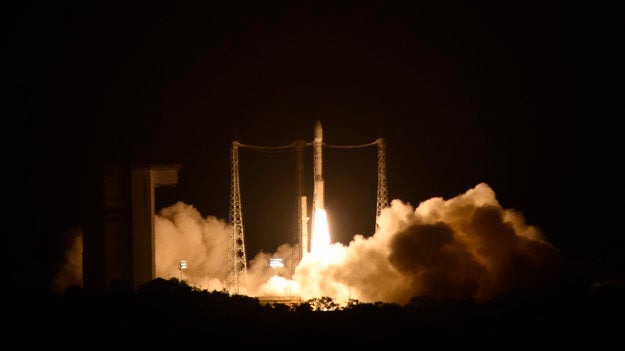
The European Space Agency (ESA) has successfully launched LISA Pathfinder, a spacecraft designed to observe tiny ripples in space known as gravitational waves.
Gravitational waves were predicted by Albert Einstein in his General Theory of Relativity.

Discover B2B Marketing That Performs
Combine business intelligence and editorial excellence to reach engaged professionals across 36 leading media platforms.
A Vega rocket, operated by Arianespace carried the spacecraft from Kourou European spaceport in French Guiana and completed the first phase of exercises needed to place it in a low and stable orbit.
LISA Pathfinder, built by Airbus Defence and Space will accomplish six different and critical engine burns over the next two weeks.
The last and sixth burn will drive the spacecraft towards its operational location, L1, 1.5 million kilometres from Earth. At that location, the spacecraft will study gravitational waves.
Einstein predicted that gravitational waves are created by rushing enormous objects and their fluctuations are universal in nature. Due to their tiny sizes, they have not been detected until today.

US Tariffs are shifting - will you react or anticipate?
Don’t let policy changes catch you off guard. Stay proactive with real-time data and expert analysis.
By GlobalDataLISA Pathfinder will try to demonstrate technology that can be used by observatories to detect the waves in future.
ESA director general Johann-Dietrich Woerner said: "Fundamental research tries to understand our world.
"Einstein’ s theoretical findings are still very impressive.
"With LISA Pathfinder, we will try to take a further step towards confirmation of one of Einstein’s predictions: gravitational waves. "
Approximately three weeks after the launch, LISA Pathfinder is scheduled to reach its operational orbit and start its main mission for the next six months.
Depending on the success of LISA Pathfinder, ESA will open a larger space observatory in the future that will directly observe and detect microscopic disturbances in space-time caused by gravitational waves.
The ESA, for its third Large Class L3 mission, already designated the gravitational universe science theme, with an aim to help astronomers studying the universe and other mysterious incidents, including bumping supermassive black holes from a whole new perspective.
ESA LISA Pathfinder project scientist Paul McNamara said: "After many years of development and testing on the ground, we are looking forward to the ultimate test, which can only be run in space.
"In a few weeks, we will be exploring the very nature of gravity in space, gaining the confidence to build a full-scale space observatory to study the gravitational universe in the future."
ESA scheduled the launch of LISA Pathfinder on December 1. Due to technical issues experienced by the Vega launch vehicle, the launched was delayed by two days.
Image: Lift off of Vega VV06 carrying LISA Pathfinder. Photo: courtesy of ESA.


