

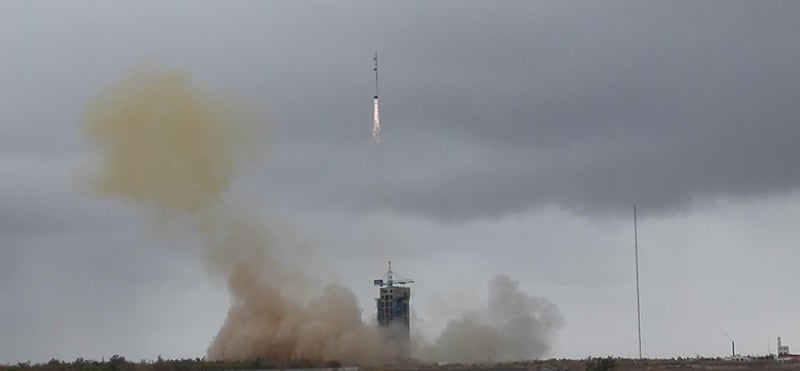
A Long March 2D (LM-2D) rocket manufactured by China's Shanghai Academy of Spaceflight Technology (SAST) has launched the Venezuelan Remote Sensing Satellite (VRSS-2) unit into space from Jiuquan Satellite Launch Centre in China's Gansu province.
VRSS-2 is the third probe to be launched by China for Venezuela. It follows the delivery of Venezuela's first communication satellite known as Venesat-1 in 2008, as well as the first Venezuelan Remote Sensing Satellite, VRSS-1, in 2012.

Discover B2B Marketing That Performs
Combine business intelligence and editorial excellence to reach engaged professionals across 36 leading media platforms.
The 1.6m-long, 2.1m-high VRSS-2 instrument weighs roughly 942kg and is set to be positioned in a Sun-synchronised orbit approximately 645km from Earth.
Venezuelan president Nicolás Maduro was quoted by telesurtv as saying: “This is technological independence that we are conquering in the great strategic partnership with our brothers of the People's Republic of China.
“This represents a military civic effort.”
VRSS-2 is Venezuela's second remote sensing satellite and will be able to help perform surveys on land resources and environmental protection, as well as assist with natural disaster mitigation, estimate the yield of crops and help urban planning initiatives.

US Tariffs are shifting - will you react or anticipate?
Don’t let policy changes catch you off guard. Stay proactive with real-time data and expert analysis.
By GlobalDataThe satellite is also expected to facilitate the development of Venezuela’s national economy in order to improve the living conditions of the local people.
China Aerospace Science and Technology Group (CASC) subsidiary China Great Wall Industry (CGWIC) served as the prime contractor of the VRSS-2 project.
CASC has also worked with various subcontractors to design, develop, test and provide the satellite's in-orbit delivery.
A series of improvements to VRSS-2's ground monitoring, reception, data processing and distribution systems are also expected to be jointly performed by CASC and the project's various subcontractors.
Image: Launch of VRSS-2 satellite by LM-2D rocket. Photo: courtesy of the China Great Wall Industry Corporation.


