

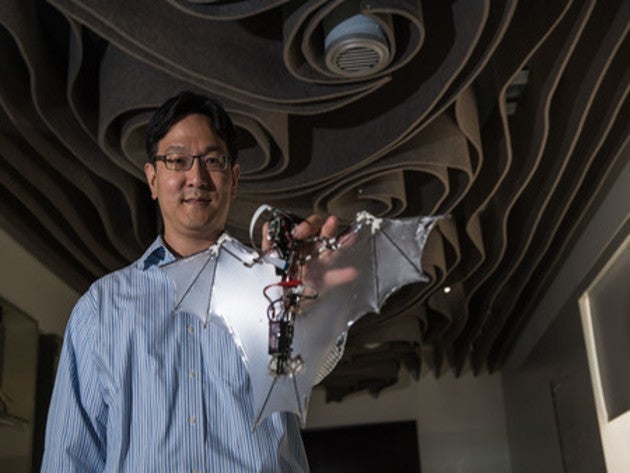
Researchers from US-based California Institute of Technology (Caltech) and the University of Illinois at Urbana-Champaign (UIUC) have developed an autonomous flying robot that mimics the flight characteristics of real bats.
According to the researchers, the newly developed Bat Bot (B2) design could be used where traditional quadrotor drones might collide with objects or people, causing damage or injury.

Discover B2B Marketing That Performs
Combine business intelligence and editorial excellence to reach engaged professionals across 36 leading media platforms.
Developed by Caltech's engineering and applied science bren scholar Soon-Jo Chung, in partnership with Alireza Ramezani and Seth Hutchinson from UIUC, B2 is a self-contained robotic bat with soft, articulated wings.
The 93g B2 has a 1ft wingspan and can alter its wing shape.
Chung said: “This robot design will help us build safer and more efficient flying robots, and also give us more insight into the way bats fly.”
During the research, funded by the US’ National Science Foundation's National Robotics Initiative, the researchers also developed tailor-made, 56 microns, silicone-based membrane that simulates stretchable and thin bat wings.

US Tariffs are shifting - will you react or anticipate?
Don’t let policy changes catch you off guard. Stay proactive with real-time data and expert analysis.
By GlobalDataWhen the B2 flaps its wings, the wings membranes fill up with air and deform, simulating the mechanism of a real bat flight.
The researchers noted that at the end of the wings' downward flapping motion, the membranes snap back to their usual shape and blast out the air, creating a huge amplification in power for the flap.
In addition, bat-inspired aerial robots have the potential to consume less energy than existing flying robots.
Image: Using a custom-made silicon skin and articulated morphing wings, Soon-Jo Chung and researchers from UIUC created Bat Bot (B2). Photo: courtesy of Caltech.


