
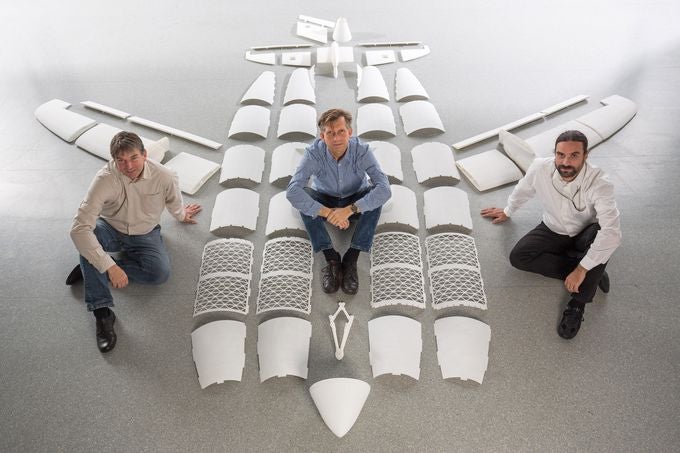
French plane maker Airbus has tested a small-sized pilotless aircraft prototype known as testing high-tech objectives in reality (THOR), which implements 3D printing or additive layer manufacturing processes.
Powered by two 1.5kW electrically driven propellers, the initial THOR version weighs around 21kg and can fit in a 4m² area.

Discover B2B Marketing That Performs
Combine business intelligence and editorial excellence to reach engaged professionals across 36 leading media platforms.
It is reported that 90% of THOR’s structural components were 3D-printed from plastic polyamide powder.
Airbus Germany emerging technologies and concepts activity official and THOR project lead Detlev Konigorski said: "This mini aircraft does not represent an actual airliner design Airbus is considering, rather it is a platform to enable low-risk and fast-track development of different technologies in real flying conditions.
"The first version was to test whether the slogan ‘Print me an airplane’ can be converted into reality."
THOR includes an existing design concept and around seven weeks were required to print its 60 structural segments, followed by around one week for assembly and three days to fine tune the electrical systems before it was flight-ready.
Compared with traditional manufacturing process, 3D-printing has reduced the development time for producing the technology demonstrator of THOR.
Last year, THOR made its initial flight and has recently resumed testing.
Konigorski added: "The first flight was simply about flying.
"Now, we want to generate basic data on things like altitude, speed and acceleration in a turn."
Follow-on THOR versions are currently being assembled at Airbus’ new Center of Applied Aeronautical Research in Hamburg, Germany.
These under development aircraft will feature a modular design allowing for greater flexibility in airframe and structural testing.
Upon completion of the wing testing, Airbus and Airbus Defence and Space will focus on artificial intelligence of the THOR project.
Airbus plans to enable THOR aircraft to land completely on its own, recognising obstacles on the runway and determining whether it is safe to touch down without support from any ground infrastructure.
Image: Airbus has tested a small-sized pilotless 3D printed aircraft prototype THOR. Photo: courtesy of Airbus.


