
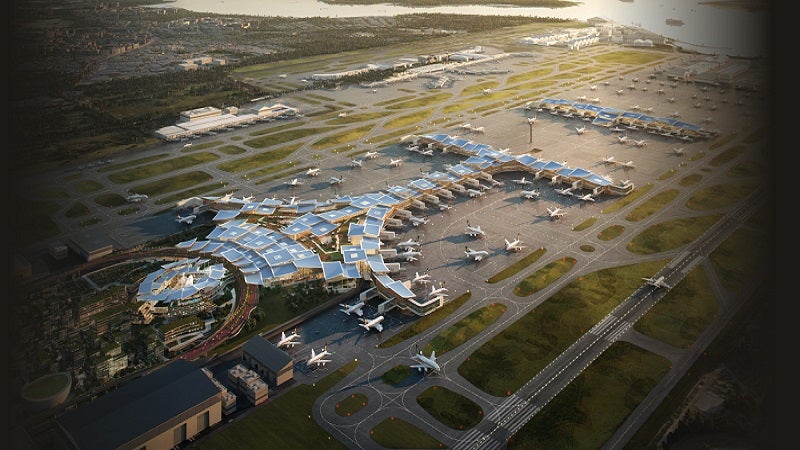
Singapore’s Changi Airport (SIN) has resumed the Terminal 5 (T5) project after revising its designs to make it greener and more pandemic-ready.
Work on the project was paused for two years due to the Covid-19 pandemic.
Go deeper with GlobalData


Discover B2B Marketing That Performs
Combine business intelligence and editorial excellence to reach engaged professionals across 36 leading media platforms.
The T5 project was first announced in 2013, and undertaken by the Ministry of Transport (MOT), the Civil Aviation Authority of Singapore (CAAS) and Changi Airport Group (CAG).
During the period when construction was paused, MOT, CAAS, and CAG reviewed T5’s design to make it more modular and to enhance its resilience and sustainability.
Based on the lessons learned from the pandemic, changes have been made to the T5 design to make it more flexible to operate as smaller sub-terminals when required.
In order to minimise the spread of diseases, the new terminal will have contactless systems at passenger touchpoints as well as enhanced ventilation systems.
US Tariffs are shifting - will you react or anticipate?
Don’t let policy changes catch you off guard. Stay proactive with real-time data and expert analysis.
By GlobalDataThe T5 terminal will feature advanced technologies to automate airport operations.
It could have autonomous vehicles to support baggage and cargo transport on the airside, as well as robotics for baggage handling.
Additionally, the new terminal will be equipped with solar panels and smart building management systems to reduce the carbon footprint.
It will also have the ability to incorporate the usage of sustainable aviation fuel (SAF) as well as the provision of fixed ground power and cooling for aircraft parked at the gates.
It will be a Green Mark Platinum Super Low Energy Building as certified by the Building and Construction Authority.
Covering 1,080 hectares of land area, the T5 terminal will have a capacity to accommodate 50 million passengers annually.
It will be built in two phases, in line with traffic growth.
Construction is expected to begin in about two years, with the terminal anticipated to become operational by the mid-2030s.



