
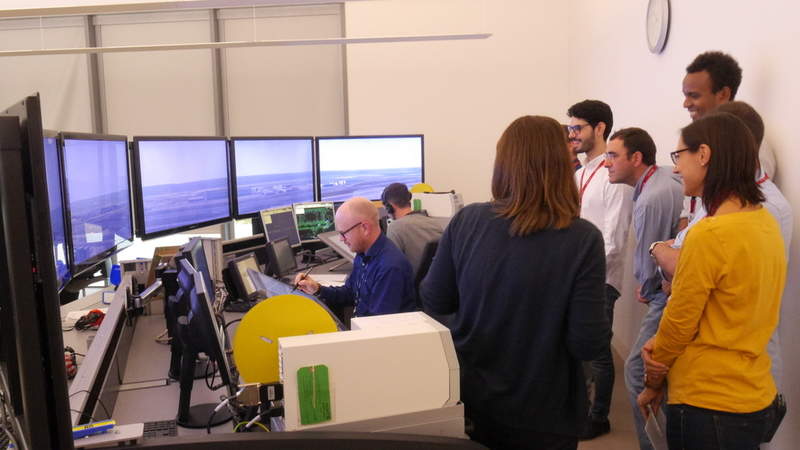

Simulations hosted by the UK air navigation service provider (ANSP) NATS have highlighted that runway operations at some of busiest airports across Europe have the potential to be made more efficient.
The simulations have been hosted as part of the European Single European Sky Air Traffic Management Research (SESAR) 2020 programme.
Go deeper with GlobalData

Discover B2B Marketing That Performs
Combine business intelligence and editorial excellence to reach engaged professionals across 36 leading media platforms.
Based on their wake vortices or invisible spirals of air turbulence they generate, the departing aircraft are divided into two broad categories, heavy or medium.
This categorisation, however, implies that separations between individual aircraft could be larger than is necessary for safe separation.
The simulations have evaluated the potential for refining the separations between departing aircraft by shifting from the current broad categories of aircraft to individual ‘pairwise’ separations.
In case of pairwise separations, the safe separation between departing flights is calculated on the basis of the wake vortices created by each aircraft type.
The current simulations are designed based on work that was previously carried out through the SESAR 1 project focusing on wake vortex optimisation, including research on pairwise separation for arriving flights and the successful integration of time-based separation (TBS) for aircraft arriving at London Heathrow Airport, UK.
The simulations have also studied the change in the dissipation of wake vortices that might occur in different weather conditions.
NATS wake optimisation concepts and analysis lead Claire Pugh said: “Whilst these are early stage prototype simulations, the findings have been promising and demonstrate the potential to help airports such as Heathrow, as well as others across Europe, to further enhance runway throughput.
“We will now use this information and work with our partners within the SESAR 2020 programme to prepare for more advanced simulations in 2018.”
Additional simulations will be hosted by other members of the project throughout this year and the next.
Image: Simulations hosted by NATS as part of SESAR 2020 programme. Photo: courtesy of NATS Limited.


