
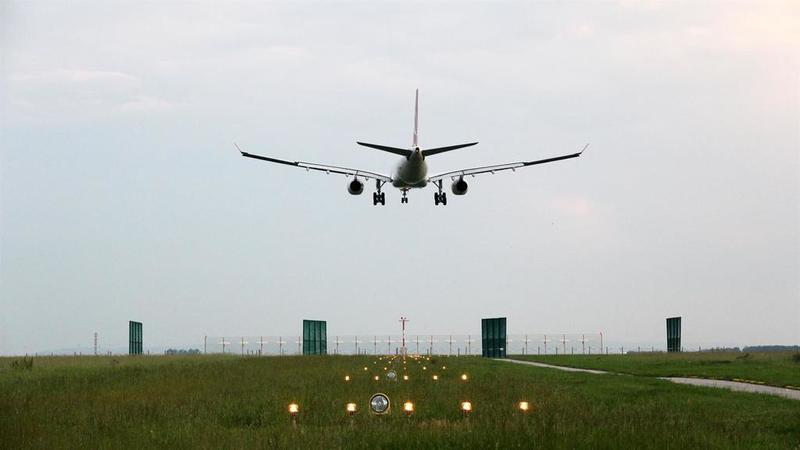
Austro Control and the German Aerospace Center (DLR) are working on a project designed to reduce wake turbulence during landing approaches at Vienna International Airport.
Researchers are using a DLR-patented configuration of parallel ground plates to accelerate the dissipation of wake vortices.
Go deeper with GlobalData


Discover B2B Marketing That Performs
Combine business intelligence and editorial excellence to reach engaged professionals across 36 leading media platforms.
The behaviour of wake vortices will be recorded using a laser measurement system for subsequent assessment.
The project, dubbed wake turbulence separation optimisation, intends to demonstrate the effectiveness of the plate lines in the landing area at large airports.
For the trials at Vienna Airport, DLR designed an installation featuring two plate lines of eight and nine ground plates respectively, which were placed in front of runway 16. The plates are around 9m long and 4.5m high.
DLR said that while wake vortices at altitude tend to rapidly descend, drift away and dissipate, they can hover for some time near the ground.
A system of plates arranged in parallel one behind the other can reduce the circulating vortices in front of a runway more quickly, DLR noted.
Austro Control director of the air traffic management department Christian Kern said: “The project team has done a great deal to enable this unique system to be tested during full-scale operations at a busy airport. Initial results are very encouraging, and if the effectiveness of the plate lines is fully confirmed, as expected, they will be able to provide increased safety and capacity at all airports in the future.”
Austro Control and its partners are also testing the effectiveness of the plates during live operations.
Leonardo Germany and RPG-Radiometer Physics are providing additional, extensive meteorological measurement equipment.
The project is part-funded by the EU under the Single European Sky and Horizon 2020 research programmes.
DLR is the national aeronautics and space research centre of Germany. It employs roughly 8,000 people at 20 locations in the country.


