

A new report from Carbon Tracker, an “independent financial thinktank,” has suggested Sustainable Aviation Fuel (SAF) will not “provide a near-term solution” for the decarbonisation of the commercial aviation industry.
Fuel Disclosure | Sustainable. Abundant. Feasible – why SAF is unlikely to be all three at once, is not anti-SAF and recognised the use of alternative jet fuels in the future decarbonisation of the industry. But it also downplays the runaway claims from some in aviation that SAF could be a short-term saviour for the industry.
Go deeper with GlobalData


Discover B2B Marketing That Performs
Combine business intelligence and editorial excellence to reach engaged professionals across 36 leading media platforms.
2030 is cited as a near-term goal for increased uptake of SAF, but Carbon Tracker said the current plans for development and production will not allow for wide-scale decarbonsation.
“Even if all existing, under-development and announced projects ran at capacity, they would only be able to displace 5% of fossil jet fuel by 2030,” it explained.
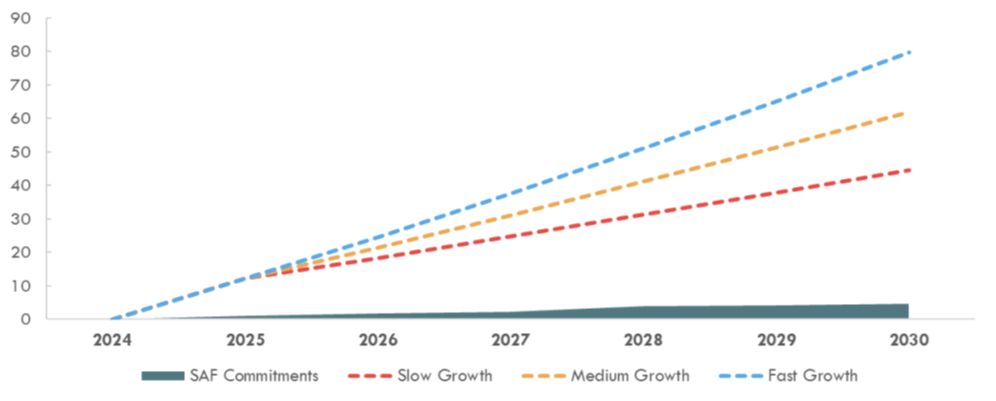
While the growth in commitments and SAF deals is encouraging, there are key practical problems that will limit its growth.
Perhaps the most crucial of these leads from the most abundent production method for current SAF: crop and waste-based feedstock. While a September 2025 IATA report said 10,000Mt of feedstocks could used to make SAF, “only 12.3% of that would be available for use in aviation, after accounting for competing uses” according to Carbon Tracker.
“The overwhelming majority of alternative jet fuel today is derived from waste oils such as used cooking oil, which are a relatively more sustainable option than others. However, these feedstocks are in very short supply.”
Not only is the raw amount of available product to turn into SAF highly questionable, the infrastructure to actually do this is in its infancy. “Setting up an infrastructure to collect, transport, and pre-process feedstock is likely to take significant investment and time to scale up,” the report noted.
Because waste oil is a commodity fought over by many industries hoping to use it to lower their carbon emissions, “the industry will have to rely on other options, some of which are much more emission-intensive, and others can carry significant implications not yet assessed by the industry.”
Carbon Tracker’s analysts made the point that many of the so-called Sustainable Aviation Fuels actually emit almost as much CO2 as conventional kerosene.
Saidrasul Ashrafkhanov, Carbon Tracker analyst and report lead author, said: “On top of high costs, offtaker hesitation and financing constraints, most alternative jet fuels are also saddled with a handful of environmental downsides. These fuels may some day have a larger role in decarbonising aviation, but the burden of proof is on the industry to show that it can find a pathway that will deliver alternative jet fuel that’s at once sustainable, abundant, and feasible.”
Although the future of SAF and long-haul, carbon-intensive flight is questionable, the thinktank pointed to short-haul flights of 270 nautical miles (500 km) or less as an area with more potential for faster decarbonisation through alternative fuels.
“Battery-electric and hybrid-electric aircraft carrying 5-100 passengers are approaching entry into service, offering a direct path to zero-emission operations on regional legs. Hydrogen-electric aircraft could open up medium-haul markets from the mid-2030s. This creates a clearer near-term investment case and preserves scarce sustainable AJF for long-haul. Despite this potential, new-propulsion aircraft remain underfunded relative to AJF.”
While the SAF realities are difficult to overcome, and other fuels for short haul flights may be more useful in the short to mid-term, Carbon Tracker and the report authors suggested an urgent change is needed to the regulatory environment to push industry toward a coherent trajectory to decarbonisation.
Rich Collett-White, Carbon Tracker energy analyst and report co-author, said: “A bewildering array of policies designed to scale up alternative jet fuels is causing confusion, with definitions and eligibility criteria differing from jurisdiction to jurisdiction. Consistent rules are needed to ensure fuels with high environmental integrity are prioritised, and unintended consequences avoided.”
The full report is available at Carbon Tracker’s website.


