
The aviation industry has been severely impacted due to the travel restrictions imposed during the COVID-19 pandemic.
Verdict has conducted a poll to analyse in which area the airlines should focus on for their mid-term sustainability plan, as an effect of COVID-19.

Discover B2B Marketing That Performs
Combine business intelligence and editorial excellence to reach engaged professionals across 36 leading media platforms.
Analysis of the poll results shows that financial management, and innovation and use of new technologies should be the focus area, as opined by 59% and 53% of the respondents, respectively.
Further, 41% believed that interaction with customers should be focused upon by the airlines and 20% voted for consolidation, and mergers and acquisitions to be the focus area.
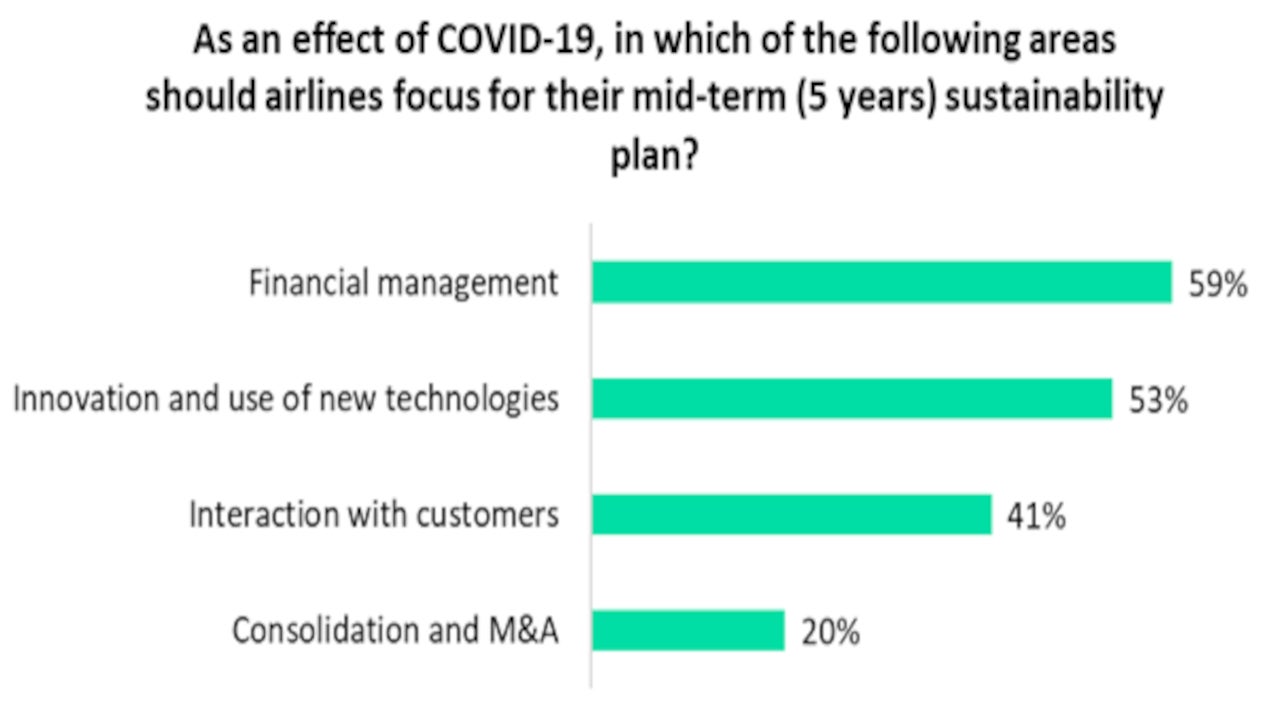
The analysis is based on 158 responses received from the readers of Aerospace Technology, a Verdict network site, between 08 July 2020 and 29 March 2021.
Airlines’ mid-term sustainability plan amid COVID-19
Most airlines are considering multiple transformation programmes in order to dilute the impact of COVID-19 and incorporate elements of sustainability. European Union, for example, is proceeding with European Green Deal to align with the improved environmental awareness of their customer base and incorporate social responsibility among the industry’s executives and employees.
Sustainability in the airline industry can be improved by enhancing operational efficiency, adopting innovative aircraft architectures and multi-modal transportation, according to the Solar Impulse Foundation (SIF), an environmental non-profit organisation. The operational efficiency and safety of the aircraft, for example, can be enhanced by using artificial intelligence (AI)-driven functions.
Similarly, new engine layouts, sustainable aviation fuel (SAF), and aerodynamic aircraft designs can improve performace and generate positive environmental effects, while making the best use of different modes of transport can reduce the need for unnecessary regional flying, adds SIF. The New Zealand government, for example, has agreed to use lower-emitting biofuel blend across the transportation industry. Further, BP and Qantas have collaborated to reduce carbon emissions in the aviation industry and to develop a SAF industry in Australia.


