
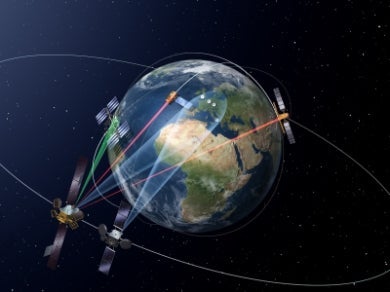
EDRS-A, the first relay satellite in the European Space Agency’s (ESA) SpaceDataHighway high-speed laser communications programme will be launched into orbit on 28 January.
It will be launched aboard a ISL Proton rocket from the Baikonur launch site in Kazakhstan.

Discover B2B Marketing That Performs
Combine business intelligence and editorial excellence to reach engaged professionals across 36 leading media platforms.
EDRS was developed at a cost of €500m, which will provide near-real time data relay of up to 50 Tbytes per day using laser technology.
A Eutelsat 9B satellite that weighs 5t and is being developed by Airbus Defence and Space, will carry the EDRS-A as a hosted payload.
Once launched, Eutelsat 9B will be positioned over Europe at 9° East and Eutelsat will operate the EDRS-A communication node to be carried by the satellite.
EDRS-A has been developed under a public-private partnership (PPP) between ESA and Airbus Defence and Space.
EDRS-A is expected to offer high speed laser communications in space of up to 1.8GB per second and transmit high volume data including images, video and data.
Data is collected by sensors from Earth observation satellites, UAVs and surveillance planes positioned over Europe, Africa, Latin America, the Middle East and the northeast coast of America, as well from the International Space Station.
Airbus Defence and Space communications, intelligence and security (CIS) business head Evert Dudok said: "SpaceDataHighway is the equivalent of optical fibre in space.
"It will revolutionise satellite and drone communications, and help to keep the European space industry at the forefront of technology and innovative services."
EDRS-SpaceDataHighway project was co-financed and co-developed by Airbus Defence and Space and German National Aeronautics and Space Research Centre (DLR).
Airbus will own and is responsible for operating and commercialising the EDRS system.
EDRS’s major component of the payload includes a laser communication terminal (LCT), which has been built by Airbus Defence and Space’s subsidiary Tesat Spacecom.
SpaceDataHighway system’s second satellite EDRS-C is scheduled to be launched in 2017.
Airbus Defence and Space and the ESA are planning to expand capacity of the system and provide global coverage by 2020. Under the expansion plan, a third node will be positioned over the Asia-Pacific region.
The European Commission will use the SpaceDataHighway system, which has the capability to help various institutions, to provide up-to-date information during emergencies or natural disasters.
Image: SpaceDataHighway system. Photo: courtesy of Airbus Defence and Space.


