
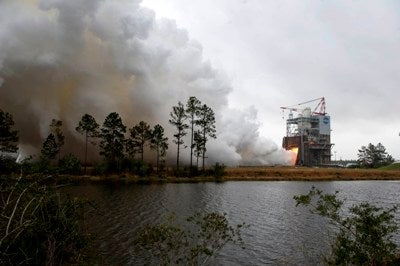
Nasa has collaborated with Aerojet Rocketdyne to test-fire a RS-25 flight engine, known as E2059, for its new Space Launch System (SLS) heavy lift launch vehicle for 500s.
The test was conducted at Nasa’s Stennis Space Center in Mississippi, US.

Discover B2B Marketing That Performs
Combine business intelligence and editorial excellence to reach engaged professionals across 36 leading media platforms.
According to the space agency, the next time the E2059 engine fires, it will be carrying passengers on the first deep-space mission in more than 45 years.
The engine is expected to fly on the core stage of SLS on its second flight, which is planned for 2021.
By late next year, Aerojet is planning to test four other flight engines in preparation for Nasa’s inaugural Exploration Mission-1 launch in 2018.
Apart from testing the new controller, several other tests were also conducted, which include testing of a rebuilt high-pressure fuel turbopump, calibration of facility and engine flowmeters, as well as testing of simulated flight environment settings.
Aerojet Rocketdyne CEO and president Eileen Drake said: "This rocket will take humans farther and faster into the solar system than we have ever travelled and increase our capability of making exciting new discoveries by launching large astronomical observatories and other scientific missions."
Being the main contractor for the RS-25 core stage engines, the company last year conducted more than 3,700s of testing on the first RS-25 development engine to demonstrate the engines’ capacity to survive various challenging operating conditions of flight, as well as the performance of the new controller.
Designed for future deep space missions, these engines have to operate in extreme temperatures ranging from -423°F to 6,000°F, and at pressures of more than 7,000lb for every square inch.
Image: Nasa conducts test firing of RS-25 rocket engine no. 2059. Photo: courtesy of Nasa.


