
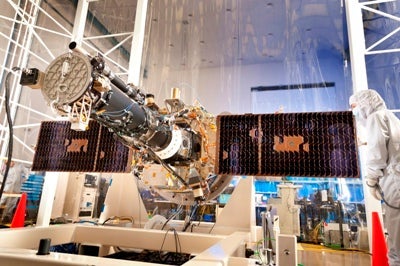
Nasa has extended a contract to use the Lockheed Martin-built interface region imaging spectrograph (IRIS) until September 2018, with an option of a one-year extension.
Under the new $19.4m deal, Lockheed Martin will assist Nasa’s orbiting observatory by providing detailed images of the Sun’s lower atmosphere, and offering insights on how solar flares are produced and release magnetic energy.

Discover B2B Marketing That Performs
Combine business intelligence and editorial excellence to reach engaged professionals across 36 leading media platforms.
The new contract has also extended the duration of both the atmospheric imaging assembly instrument onboard the solar dynamics observatory and the solar optical telescope onboard the Hinode satellite.
Over the next few years, IRIS will focus on more specific computer models that disclose what heats the sun's chromosphere, a layer of the Sun's atmosphere that is responsible for most of the ultraviolet light being received on Earth.
The IRIS observatory will also focus on coordinated and highly complementary observations with a several ground-based telescopes that are coming online.
Lockheed Martin’s Advanced Technology Centre IRIS science lead Dr Bart De Pontieu said: “IRIS has taken more than 24 million images or spectral measurements of the sun since its launch three years ago, and it has led to more than 115 scientific papers.
“In this new extension, IRIS will be able to study a wide range of phenomena, including the source regions of fast solar wind, a stream of charged particles that continuously emanates from the sun at speeds of 1,000km/s and fills the space around the Earth.”
The company said that currently IRIS could view only a small part of the Sun at any time, but with more planning by the IRIS science planning the observatory would be able to seize nine of the largest flares (X-class) and almost 100 of the second largest class of flares (M-class) and numerous weaker C-class flares.
Image: The interface region imaging spectrograph has been giving a zoomed-in view of the Sun since its launch in 2013. Photo: courtesy of Lockheed Martin Corporation.


