

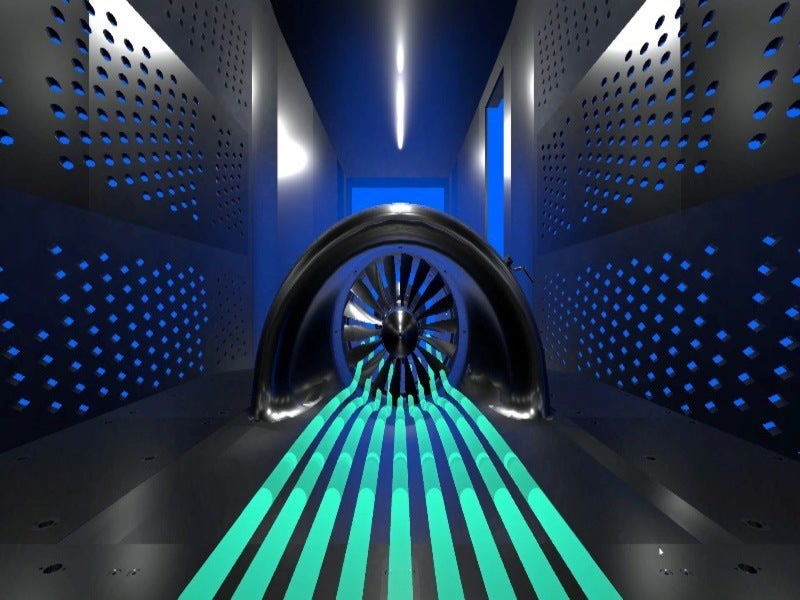
Nasa’s Glenn Research Center in Cleveland, US, has started the testing of a new fan and inlet design with the aim of helping the aircraft industry to reduce fuel consumption and emissions.
Commonly known as a propulsor, the new design could increase fuel efficiency by 4%-8% more than the advanced engine designs that are now being used by the airlines.

Discover B2B Marketing That Performs
Combine business intelligence and editorial excellence to reach engaged professionals across 36 leading media platforms.
During the inaugural test, Nasa has placed the engines away from the aircraft’s body to avoid ingesting the boundary layer, which is formed by slower flowing air that develops along the aircraft’s surfaces.
Nasa Glenn Research Center boundary layer ingesting propulsion expert David Arend said: “Studies backed by more detailed analyses have shown that boundary layer ingesting propulsors have the potential to significantly improve aircraft fuel efficiency.
“If this new design and its enabling technologies can be made to work, the BLI propulsor will produce the required thrust with less propulsive power input.
“Additional aircraft drag and weight reduction benefits have also been identified.”
It is believed that the fuel burn can be reduced by embedding an aircraft’s engines into these surfaces and ingesting the boundary layer air flow to propel the aircraft through its mission.
The tests for the new propulsor is being carried out at Nasa Glenn Centre’s new 8ft x 6ft transonic wind tunnel.
The agency will use a rugged boundary layer ingesting (BLI) inlet-fan combination, designed by United Technologies Research Center, along with Virginia Polytechnic and State University, US.
During the entire phase of testing, the Nasa team is planning to change the wind speed and vary the boundary layer thickness and fan operation to see how these changes affect the propulsor’s performance, operability and structure.
Test results can be applied to various aircraft designs being pursued by Nasa, as well as by its academic and private industry partners.
Image: Nasa tests new jet engine design to help reduce fuel consumption. Photo: courtesy of Nasa.


