

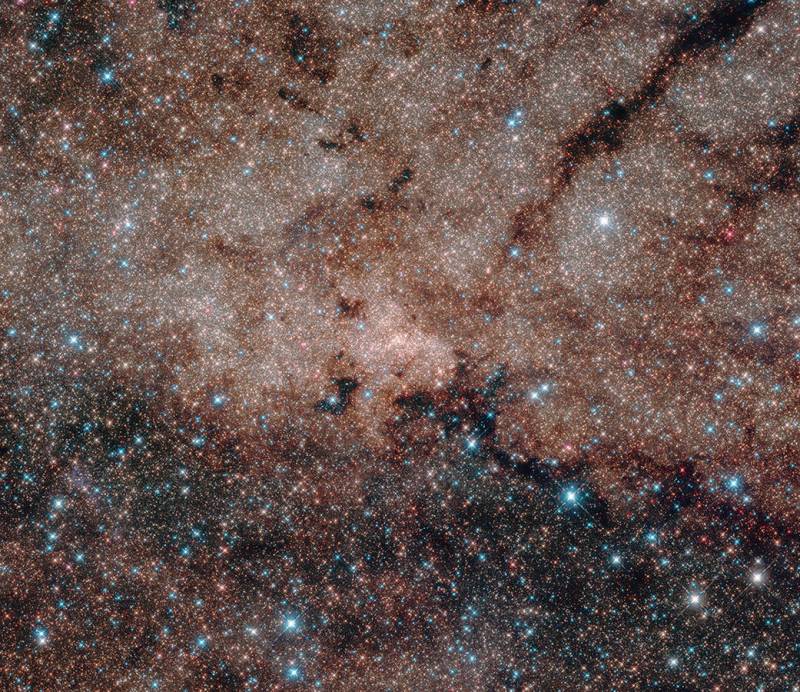
Nasa has selected its Galactic/Extragalactic ULDB Spectroscopic Terahertz Observatory (GUSTO) science mission to measure emissions from the interstellar medium, which is the cosmic material found between stars.
To be led by principal investigator Christopher Walker from the University of Arizona, US, the GUSTO mission will fly an Ultralong-Duration Balloon (ULDB) carrying a telescope with carbon, oxygen and nitrogen emission line detectors.

Discover B2B Marketing That Performs
Combine business intelligence and editorial excellence to reach engaged professionals across 36 leading media platforms.
The mission is also expected to provide spectral and spatial resolution information, which will help understand the complexities of the interstellar medium.
Using a $40m investment, the GUSTO mission is expected to be launched by 2021 from McMurdo, Antarctica.
Nasa Washington science mission directorate astrophysics division director Paul Hertz said: “GUSTO will provide the first complete study of all phases of the stellar lifecycle, from the formation of molecular clouds, through star birth and evolution, to the formation of gas clouds and the re-initiation of the cycle.
“Nasa has a great history of launching observatories in the Astrophysics Explorers programme with new and unique observational capabilities. GUSTO continues that tradition.”
The agency also noted that it is planning to keep the mission in air for around 100 to 170 days, depending on weather conditions.
For the GUSTO mission, Johns Hopkins University Applied Physics Laboratory in Laurel, Maryland, will provide the mission operations and the balloon platform, where the instruments are mounted, known as the gondola.
The University of Arizona will provide the GUSTO telescope and instrument, which will be equipped with detector technologies from Nasa’s Jet Propulsion Laboratory in Pasadena, California, and other institutes.
Image: Nasa selects a science mission that will untangle the complexities of the interstellar medium. Photo: courtesy of Nasa, ESA, and Hubble Heritage Team.


