
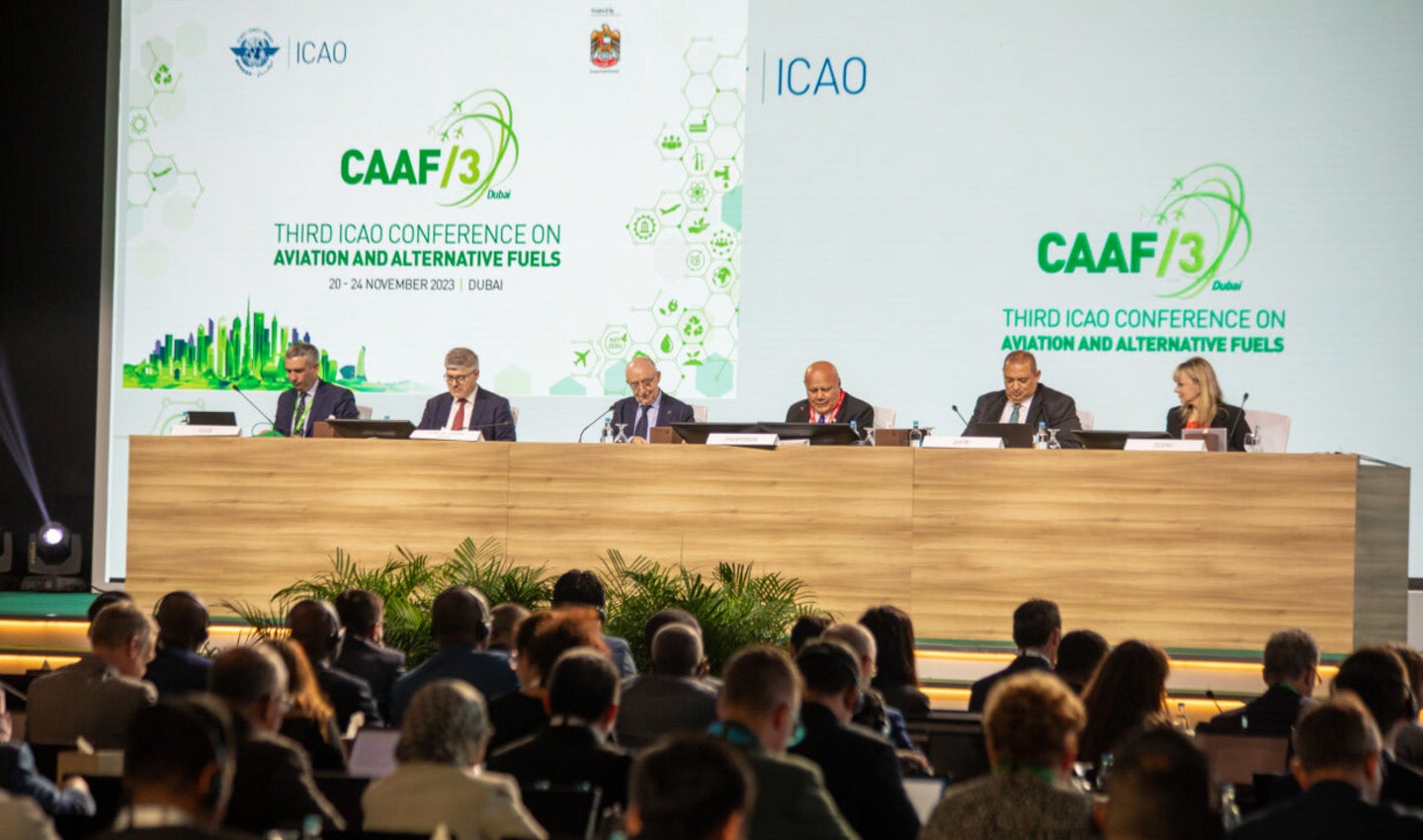
The International Civil Aviation Organisation (ICAO) has adopted a new global framework for the use of lower emission fuels in the industry as part of its ambitions to reduce CO2 emissions in international aviation by 5% in 2030.
The framework covers the use of sustainable aviation fuels (SAF), lower carbon aviation fuels (LCAF), and other aviation cleaner energies including supporting implementation initiatives, improving access to financing, and aligning regulations.
Go deeper with GlobalData

Discover B2B Marketing That Performs
Combine business intelligence and editorial excellence to reach engaged professionals across 36 leading media platforms.
ICAO Council President Salvatore Sciacchitano said that the framework would facilitate the scaling up of the technologies to provide greater clarity and consistency across the globe.
He said: “Investors, governments and others all need greater certainty regarding the policies, regulations, implementation support, and investments required so that all countries will have an equal opportunity to contribute to, and benefit from, the expansion in the production and use of these fuels and the expected emissions reductions they will lead to.”
Adopted by the United Nations agency during its third Conference on Aviation and Alternative Fuels in Dubai, the framework builds upon the industry-wide goal of reaching net zero emissions by 2050, adopted by ICAO in 2022, and continues a “No Country Left Behind” approach by allowing for countries to work within their own national timeframes by working to an overall global target.
Contrary to other international organisations like the EU, which has introduced laws to mandate the use of SAF, the ICAO said that leaving out specific, strict obligations and commitments for individual countries from the framework means that each of the 193 countries that form part of the organisation can work around their individual capabilities.
ICAO Secretary General Juan Carlos Salazar, said: “Achieving net-zero carbon emissions by 2050 will require substantial and sustained investment and financing over the coming decades.
“We must furthermore assure reliable and affordable support and capacity-building for those States with particular needs, as they will be depending on it to help play their part.”
SAFs are a group of mostly drop-in biofuels made using waste oils and feedstock that can provide up to 70% reductions in lifetime emissions compared to traditional jet fuel, while the ICAO defines an LCAF as a fossil-based aviation fuel that meets the sustainability criteria defined by the organisation’s Carbon Offsetting and Reduction Scheme for International Aviation.


