

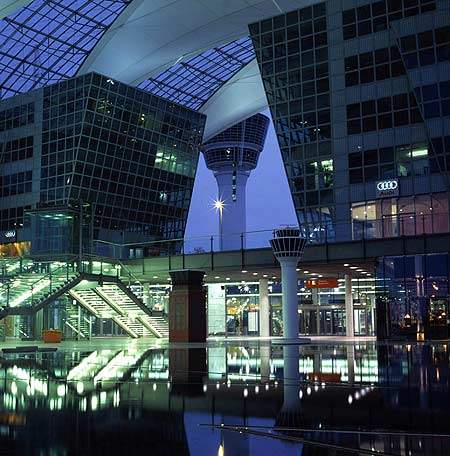
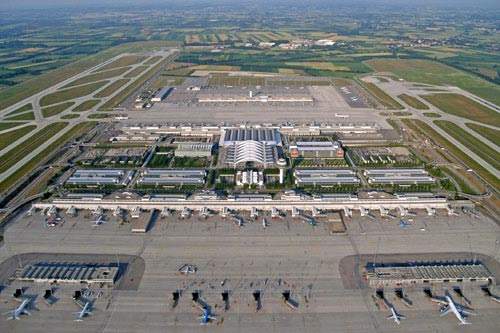
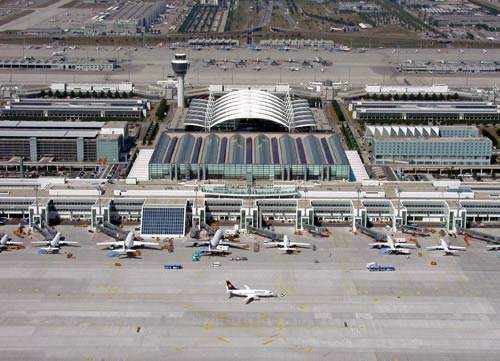
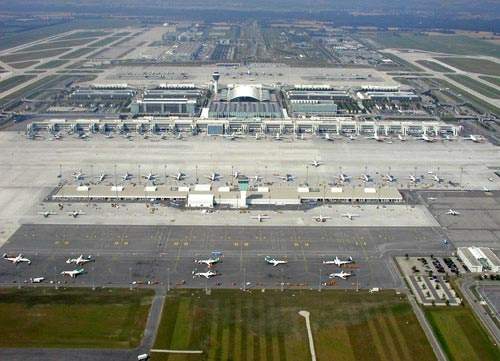
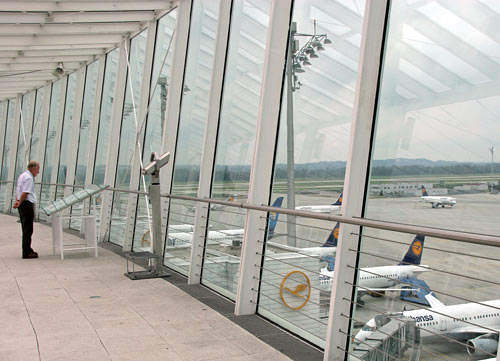
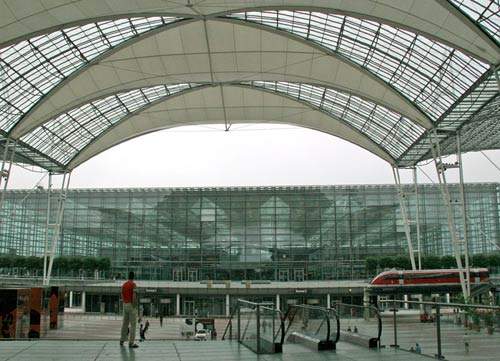
Munich International Airport (Franz Josef Strauss International Airport) is located 28km north-east of Munich, Germany, and is the major hub for Lufthansa and Star Alliance group airline operators. One of the airport’s main faults is that it is quite a distance away from the city centre.
The airport is operated by Flughafen München Gesellschaft (FMG) and can handle more than 28 million passengers a year. The airport recoreded almost 34.74 million passengers and 389,939 aircraft movements in 2010. More than 30,000 people are employed at the airport.
Recommended White Papers
Recommended Buyers Guides

In 2006 and for the second consecutive year, Munich Airport was named the ‘Best Airport in Europe’ and the third best worldwide (after Singapore Changi Airport and Hong Kong International Airport) by Skytrax.
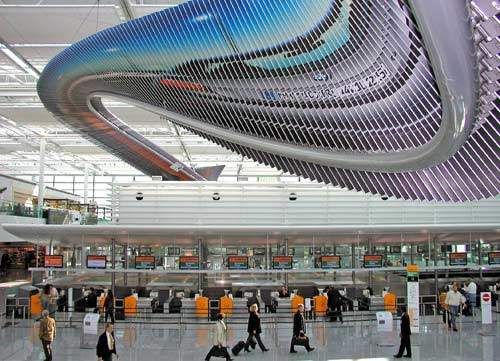
Modern airport and terminal 2
The airport is of modern design: it started construction in 1980 and began operations in 1992.
The airport has two identical runways 08R/26L and 08L/26R, both concrete paved and 13,123ft (4,000m) long. The airport expanded rapidly when it first opened; this was largely because the German airline Lufthansa chose to centre more of its operations in Munich.
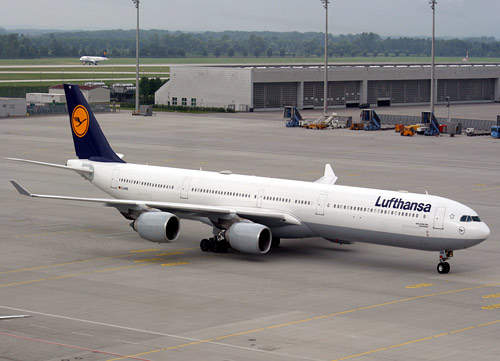
Munich handles more Lufthansa domestic flights than Frankfurt.
This rapid growth led first to an expansion of the original Munich terminal and then, in mid-2003, to the opening of a second terminal which can handle 25 million passengers a year.
Terminal 2 was jointly financed by Lufthansa and FMG and is jointly operated. The architects for terminal 2 were Koch & Partner of Munich.
In February 2011, the airport and Lufthansa unveiled their plan to construct a new satellite building near the baggage sorting hall at Terminal 2. The €650m facility is expected to be completed by 2015. The new building will offer 123,000m2 of space with 42 passport control stations and 24 transfer desks.
It will also provide more than 9,000m² retail and restaurant space. An underground passenger transportation system connects the facility to Terminal 2. FMG and Lufthansa are investing in the project in a 6:4 ratio.
Runways at Munich International Airport
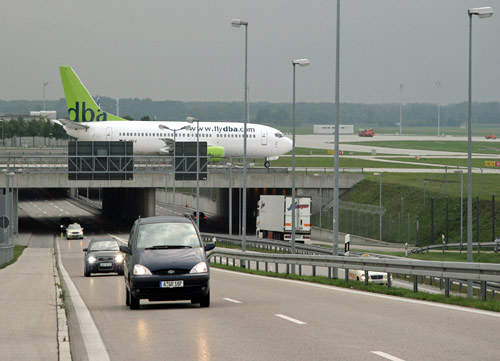
The airport has two independent, parallel runways, handling 90 aircraft movements an hour between them.
Increasing traffic and future needs have prompted the proposal for a third runway. The Upper Bavaria district government approved the proposal in July 2011. FMG will invest €100m ($142.55m) for addressing the compensation claims and other concerns related to the runway construction.
The third runway will increase the aircraft movements at the airport to 120 an hour.
Photovoltaic cells on the roof
In August 2002 the photovoltaic facility (or solar energy facility) installed by BP Solar on the roof of the check-in concourse of the new terminal 2 was connected to the airport power grid.
It is one of the largest solar facilities of its kind and produces an average of approximately 500,000kWh a year, representing the electricity needs of about 200 households.
High production of energy is guaranteed even in winter through the use of the latest polycrystalline silicon cells and the optimal alignment of the solar modules at a 20° angle facing south.
Costs for the facility totalled €2.7m. Lufthansa participated in this project as a sponsor.
Cargo handling at the German airport
After nine months of construction work the new express services hall at the south-eastern end of the freight area was officially opened in September 2005. The 4,400m² complex is jointly used by the integrated express carriers FedEx, DHL and UPS. With a total volume of 400,000t in 2006, the annual airfreight turnover at Munich has quadrupled since opening in May 1992.
One of the next cargo expansion projects will be the construction of an express cargo station and also a new larger border control office with a small animal station.
Baggage handling system
The Siemens Production and Logistics Systems Group won an order worth $93m from Flughafen München Baugesellschaft for the construction of a fully automatic baggage handling system for the new terminal 2 in Munich Airport in October 2002.
The new system (Crisbag) was able to handle up to 100,000 items of baggage a day. The time taken to change flights is crucial, which includes baggage transfer. The new terminal at Munich Airport is programmed to achieve a maximum baggage transfer time of 30 minutes, allowing for all security checks and even including special baggage like ski sacks and golf bags.
Siemens supplied the baggage handling equipment, including the automation system. Around 40km of transport and sorting belts were installed. The baggage sorting system is controlled by about 100 Siemens controls and a fully redundant computer system. The status of the facility can even be checked via the airport intranet.
Immediately after check-in, baggage is loaded onto totes, where it remains throughout the handling process. The tag on the bag (with barcode) is linked directly to the code on the tote.
Early baggage and intermediate buffer storage are integrated and an automatic tracking facility keeps tabs on each item until it leaves the correct discharge chute.
The track-and-trace system is 100% reliable as the bag stays in the same tote from check-in to discharge. All types of baggage up to 2.2m in length can be safely conveyed.
In the tote, baggage cannot suffer any damage and can be easily X-rayed by 100% hold baggage screening incorporated in the CrisBag system.
The system can transport baggage over long distances, such as between terminals. With a speed of up to 7m a second and a throughput that can be increased by adding more circuits (the system is modular), the system can reduce transfer time significantly.
It is capable of handling 19,000 items of baggage an hour to accommodate the terminal’s anticipated 20 million passengers a year (2005 figures showed 28.6 million).
In August 2011, Siemens Mobility was awarded a €63m ($89.81m) contract to extend the baggage handling system at Terminal 2. The project will increase the existing baggage storage capacity of 3,700 spaces to 4,700. About 2,000 new sorter elements will also be installed under the contract. The project is expected to be completed by November 2012.
IT technology and services at Munich International Airport
The IT department at Munich has long been known for its innovation. They were the first to introduce multiple ISP hotspots to an airport concourse. This system uses technology from Cisco Systems to allow business travellers to access the internet and email at the airport from their own ISP. Future challenges for the airport IT department include:
* Implementation of CDM (Collaborative Decision Making), which is a new concept adopted by the ECAC (European Civil Aviation Conference) for European Air Traffic Management Strategy
* Implementation of vehicle positioning (GPS, Galileo via WLAN)
* Implementation of multilateration (for accurate aircraft positioning)
* Renewal of the two flight information systems by a universal display system
* Renewal of the trunked radio
* Implementation of business intelligence
* Modernisation of the terminal CCTV systems
Long-term plans for the airport
The annual passenger volume is expected to approach 56 million by 2020.
The long-term plans of Munich International include a third runway north of the airfield to allow in excess of 120 movements an hour over all three runways.
In addition there will be additional building work and extension including a second hotel, more maintenance and administration buildings, and a fourth hall for aircraft maintenance. When the airport exceeds 40 million passengers a year a third terminal is planned to allow for an additional 20 million passengers.
There is also much work being carried out around the airport to make it ready for the A380 superjumbo.
Munich Airport rail link
In September 2007 an announcement was made that the long-standing project to build a high-speed link between the airport and the city centre at the Hauptbahnhof (main rail station) would go ahead.
The €1.85bn project was to be shared between the state of Bavaria, national rail operator DB and the Transrapid manufacturing consortium. The project was suspended in March 2008 due to budget overrun.
