


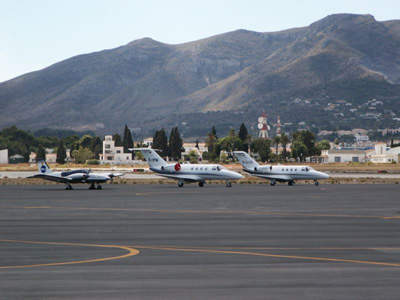


Malaga Airport is one of the best-known airports in Europe. Also known as Pablo Ruiz Picasso Airport, it is the main international airport serving the Costa del Sol in Spain, a major tourist destination.
The airport is ideally situated for this purpose, being located 8km south-west of Malaga and 5km north of Torremolinos, two popular resort and hotel locations. In June 2011, the airport was officially renamed as Aeropuerto de Malaga-Costa del Sol. The name change is an effort towards establishing the brand name of Costa del Sol in the tourism industry.
Recommended Buyers Guides

The airport facilities currently include one asphalt paved runway (13/31 10,500ft, 3,200m) – although a second runway is currently under construction and will be open by 2011 – and three terminal buildings (construction of third terminal adjacent to the existing two was completed in March 2010). In 1997 a seven-storey car park opened at the airport.
The airport is managed by the Spanish Airports and Aerial Navigation Authority (AENA) and Aeropuerto de Málaga and is undergoing a major expansion to prepare it for the expected increase in passenger numbers towards 2015 (20 million per year).
The new terminal opened on 15 March 2010. The project cost €320m ($467.4 m). Estimates are that the airport will be handling more than 24 million passengers by 2020. The airport received more than 13 million passengers during 2006.
The busiest routes are from within Europe, particularly to and from the UK and Ireland. In 2010, however, the numbers decreased and the airport received only 12.06 million passengers. The airport handled 105,631 aircraft operations the same year. With the opening of the third terminal, the airport can handle 30 million passengers annually.
Investment
Aeropuerto de Malaga-Costa del Sol is the fourth-biggest airport in Spain, absorbing 7.3% of national passenger traffic. Between 2004 and 2010 an investment of around €890m was spent on the airport, in addition to the €75m invested between 1996 and 2003. In 2006 and 2007 alone the Ministry for Public Works invested €530m in the airport. The airport authority announced it would be investing €1.8bn in the airport between 2004 and 2013.
Transport infrastructure
The airport has a number of car parks available for passengers to use; however while the expansion work is going on AENA have requested that to avoid delays and congestion passengers opt to use train and bus services in preference to their cars.
The airport has a well developed public transport system with the Cercanías–Málaga train serving the airport directly from Malaga city centre and Fuengirola. There is also an airport coach on a direct route to Marbella bus station.
In addition, the number 19 bus run by EMTSAM (Empresa Malagueña de Transportes) runs a service to Malaga bus station and the city centre from both terminals 1 and 2.
A new underground train station at the airport was completed in September 2010. It initially features suburban trains but is expected to eventually include high-speed trains in the future.
Facilities
Following the first terminal building opening in 1972 the airport became a popular hub for package holiday passengers. In 1991, the Pablo Ruiz Picasso terminal was opened (Terminal 2). This was designed by the Spanish architect Ricardo Bofill, and was constructed to be operated in combination with Terminal 1.
Terminal 2 hosts a large check-in concourse with a long row of check-in desks running left to right. After passengers check-in they have to go beyond the check-in desks themselves to access the security areas instead of having to ‘back-track’ on
themselves meaning that the check-in concourse is less congested.
Once beyond the security check point passengers can then make use of the airport’s extensive facilities, including duty free shopping and a number of restaurants. Mainland European flights depart from Pier B and UK and Ireland flights depart from Pier C.
Further airport development in the 1990s included: conversion of the old passenger building into a general aviation terminal; a new hangar for large aircraft maintenance being constructed to the north of the airport site and a new cargo terminal.
A new 54m control tower was opened in 2002 (constructed by Fomento de Construcciones y Contratas (FCC)).
Terminal design
The new developments include a third terminal and a second runway. The new terminal design was based on the dimensions and shapes, already used in the existing terminal, but the colours and materials have been adapted to current trends. The aim was to create holistic airport architecture that meets the requirements for identity.
The third terminal has an area of 385,000m² and includes 86 check-in desks, eight automatic check in machines and 48 departure gates. It extends northward with a 240ft-long loading dock that is parallel to the parking platform of the aircraft which is featured by 20 gates. The new terminal is designed to accommodate around 9,000 passengers and 7,500 piecesof luggage per hour. It has 6,000m² of restaurants, cafeterias and bars and 2,800m² of shops.
The concept design allows for reduced occupancy of apron space, better protection of the tower area and landside from noise, improved security and expansion to the north-east areas of the terminal when the second runway and double-taxiway-link between the runways are finished in 2012. One of the design basic concepts was the use of natural daylight and landscaping elements even in the basement level.
Dedicated areas have been factored in for short-term parking requirements adjacent to the departure and arrival level. The new car park building was initially designed with five floors, but it was then decided to add two more floors to provide an additional 600 parking spaces in view of increasing passenger numbers. The extended airport now has a total of 2,500 new parking spaces along with underground parking for 66 coaches.
Contractors
In 2000, Bovis Lend Lease was appointed for a one-year contract to consult on the expansion of Malaga Airport. Bovis Lend Lease has been providing technical assistance as a consultant for the expansion programme.
Bovis has taken on the objectives for the project and is working as an integrated team with the other technicians involved in the project. Bovis will be responsible for planning, control and updating of programme, operational analysis, technical assistance and project management.
The project includes the new runway construction and platforms, new terminal building, exterior works, accesses and transport systems including a new multi-storey car park, Airport Baggage Handling System (ABHS) and Automated People Mover (APM), energy systems, aircraft supply installations and integration with public transport.
W&P Architects Engineers were responsible for the design and construction of the new terminal building. Burks Green Architects and Engineers are responsible for the design and planning of the new runway, taxiways and apron areas in conjunction with Aertec of Spain (lighting and power plants).
Another project that includes the renovation of Terminal 2 is underway. The contract for technical assistance for drafting the Terminal 2 renovation was awarded to GOC SA UTE / Conurma in December 2009. The contract is worth €2,567,700.
On 30 June 2009 the airport authorities awarded a contract that includes connecting Terminal 2 with the new terminal. The contract has been awarded to Sacyr Vallehermoso and is worth €11.2m.
