

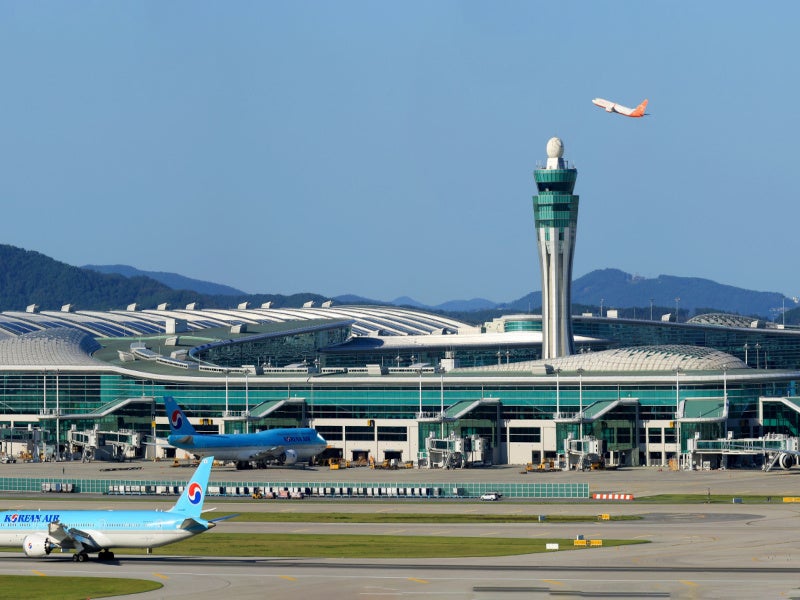
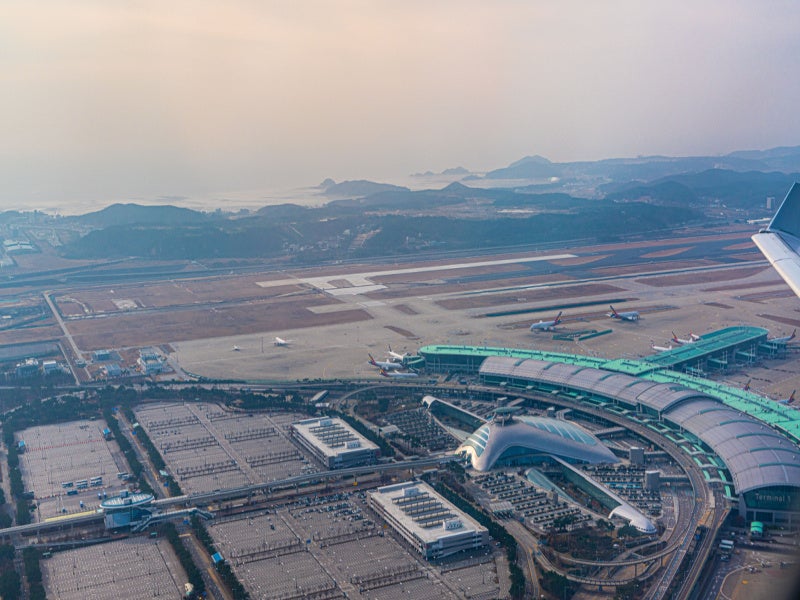
Incheon international airport is located between Yeongjongdo and Yongyu Islands in South Korea. It is operated by Incheon International Airport Corporation (IIAC).
The airport’s two runways, passenger terminal complex and other facilities completed under phase one officially opened and became fully operational in March 2001, making Incheon one of the world’s biggest cargo airports.
Recommended White Papers
Recommended Buyers Guides

Phase two expansion increased the annual flight capacity from 240,000 to 410,000, its annual passenger capacity from 30 million to 44 million, and its annual cargo capacity from 2.7 million tonnes (Mt) to 4.5Mt. Phase three expansion, which cost approximately KRW4.9tn ($4.5bn), began in September 2013 and was completed in 2018.
The phase four expansion started in 2017 with an investment of approximately KRW4.8tn ($4.8bn), and is scheduled for completion in 2024. The expansion will enable the airport to handle 600,000 flights, 106 million passengers and 6.3Mt of cargo each year.
Incheon international airport location
Incheon international airport is built on a land bridge created between the Yeongjong and Yongyu islands in the Yellow Sea.
Connected to South Korea’s mainland by the Yeongjong Bridge, the airport can service 51 cities with a population of more than one million within 3.5 hours’ flying time.
Phase four of Incheon Airport construction
The fourth phase expansion includes the expansion of Terminal 2 and the construction of Runway 4, which measures 3,750m, in addition to aprons, parking lots and roads.
Terminal 2 will have a total floor area of 347,000m2 and a passenger handling capacity of 29 million. It will include five above-ground floors and two underground floors. The Terminal 2 departure hall will feature self, group and premium check-in zones, the latest computer tomography (CT) scanners, and walk-through duty-free shops. The arrival zone will be equipped with a special baggage handling system (BHS) with ten additional carousels.
The terminal will feature a sustainable design with eco-friendly spaces, a traditional Korean garden and large outdoor parks. 24% of the building’s energy requirements will be provided by renewable energy, which will help in offsetting 12,000t of carbon emissions a year. It will also feature modern information and communications (ICT) technology, a 3D ceiling and large-screen digital media walls.
Phase four also includes the construction of Traffic Centre 2, which will extend the short-term parking lot with 1,803 additional spaces. Two additional floors will be added, increasing the capacity of the short term parking lot to more than 5,000 vehicles. The building will be installed with an integrated photovoltaic system on the ceiling.
A remote aircraft parking facility with 30 aeroplane parking slots covering 487,000m2 is also part of phase four expansion.
Runways
Phase one of the Incheon international airport comprised two parallel paved asphalt runways, 33L/15R and 33R/15L, each 3,750m-long, 60m-wide and 1.05m-thick, able to service Boeing 747-400s and capable of CAT IIIa operations.
Currently, runway 33L/15R is used mostly for departures while runway 33R/15L is used mostly for arrivals. This is especially evident from the amount of rubber present on each runway; runway 33R/15L has more rubber on it due to the constant landings.
As part of the phase two construction, the 4,000m third runway, 16L/34R, was constructed and opened in July 2008. Landing and take-offs of most passenger flights take place on the new runway and the existing runway 33L/15R, while runway 33R/15L is used mostly for cargo flights due to its proximity to the cargo terminals.
An advanced surface movement guidance and control system (SMGCS) manipulates runway and taxiway lighting to guide aircraft to gates. The automated system is specially designed for low-visibility conditions or busy surface movement traffic.
To further facilitate traffic flows, a four-lane road for support services circles the airfield and vehicles exclusively move on two four-lane underground roads beneath the runways. An airport surface detection equipment radar (ASDE) monitors runway incursion and offers conflict alert system functions.
Cargo
Incheon international airport has the capacity to park 24 cargo aircraft simultaneously. The cargo facilities are capable of handling 2.7Mt of cargo in 1,389,000ft² of cargo terminal space.
The three cargo terminals all offer automated systems for cargo transfer, including workstations and cargo-handling equipment, as well as refrigerators, freezers and temperature-controlled rooms. They are operated by Korean Air, Asiana Airlines and IIAC Foreign Carrier Cargo Terminal, respectively.
Terminal
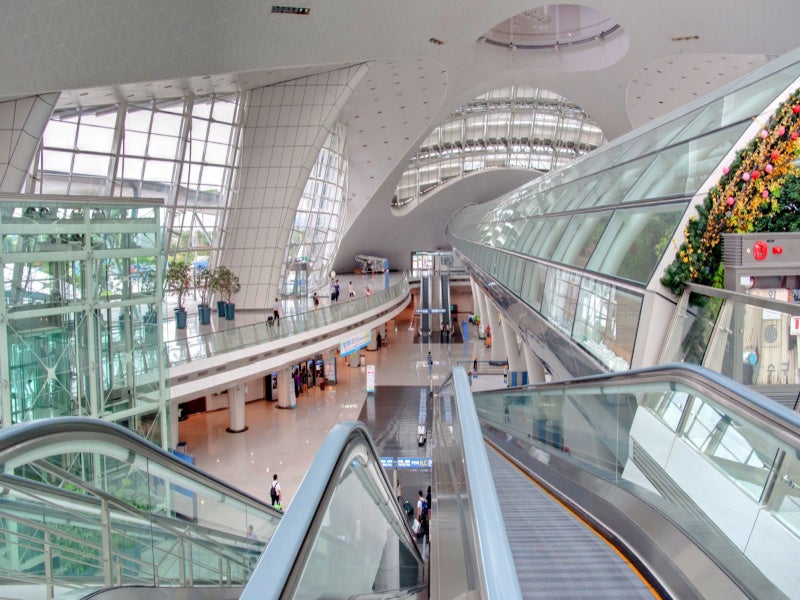
In 1996, construction began on the terminal building complex, including two terminals, four remote concourses and the Incheon Airport Transportation Centre. The main passenger terminal is the largest in South Korea, measuring 496,000m² (5.3 million ft²). It is 1,060m long, 149m wide and 33m high, and includes 44 gates and 16 aircraft stands.
An intra-airport transit system (IAT) and BHS interface space are located in the basement, with the first floor dedicated to the baggage claim area and arrivals exit.
The arrivals and immigration areas are located on the second floor, the departure hall is on the third floor and the public areas are on the fourth. Most of the international gates lead to dual passenger jet bridges.
To further accelerate the check-in and boarding process, arrival facilities include 120 immigration counters and 50 customs counters with 270 check-in counters and 28 security checkpoints, 44 boarding ports, and two biological quarantine counters. Facilities also include six stationary and 14 portable passenger quarantine counters, along with eight arrival security ports able to process a total of 6,400 passengers an hour.
The terminal complex hosts more than 195 shops and restaurants.
Control tower
Located at the epicentre of the airport, the 22-storey control tower is 100.4m tall and is illuminated 24 hours a day. On the highest floor is a parabolic antenna, which is used by the airport surface detection equipment (ASDE) to detect all airplanes and obstacles within 5km of the tower.
The upper floors are used by ground and tower controllers, while the lower floors are mostly for support operations. The control tower has a total area of 179m², making it one of the largest in the world.
Baggage handling
Incheon Airport’s BHS is designed to process 31,000 pieces of luggage an hour, using a centralised computer-controlled, automated tilt-tray system which sorts luggage with barcode readers.
The average processing times are 15 minutes for departure, five minutes for arrival and ten minutes for transfer of baggage. The system is completely automatic unless one of the barcodes cannot be read by the barcode reader, in which case the baggage with the unreadable barcode tag is automatically routed to a facility where airport employees read the barcode then have the baggage routed to the correct destination manually.
When the airport first opened, this system was found to have flaws with its automatic operation and the facility had to be operated in semi-automatic mode. The flaws have since been corrected.
Phase four of the airport expansion will add a hold baggage screening system HI-SCAN 10080 XCT, with a dual-view dual-energy X-ray line scanner with full 3D volumetric computed tomography (CT) imaging and reconstruction for more accurate analysis. It offers a high throughput of up to 1,800 bags per hour for a faster and more efficient screening process.
Self-service kiosks
IBM installed 52 internet-enabled self-service kiosks at the Incheon international airport.
The touchscreen kiosks offer visitors a variety of customised services and applications, including airport and airline location information, travel procedure information, hotel and airline reservation systems, ground transportation information and flight schedules, as well as emergency services. They also offer a range of practical tools such as currency converters and global time zone maps.
Transportation centre
Incheon airport’s transportation centre is the first gateway to the airport and is situated in the central area between the two passenger terminals. It comprises short-term parking facilities for cars, train services and a people mover.
Upon opening, access to the airport was facilitated by the newly constructed, six-lane, limited access Incheon International Airport Expressway (Freeway 130), incorporating Yeongjong Bridge. The airport is served by a frequent bus service from all parts of South Korea, as well as by a ferry service from Incheon and other nearby ports.
Airport limousines operate around the clock from Seoul to Incheon, and backup highway buses escort people from within and beyond Seoul. A highway between Incheon and Gimpo Airport was completed in late 2005.
Area control centre
A new air traffic control centre became operational in October 2001. The Korea Area Control Centre (KACC) is in Incheon and oversees aircraft movements within the Korea Flight Information Region.
Lockheed Martin was awarded a contract to provide a SkyLine air traffic management system adapted to the Korean region, with Samsung Data Systems providing consoles, installation and training as the prime contractor. Contracts were awarded in 1999 and at the time of the centre’s opening, the traffic control system was used to control around 860 daily aircraft movements in the region.
International business centre
Plans are underway for Incheon City and the airport to develop as a major business centre with office buildings and two airport hotels.
The airport is now building a new development nearby, on the other side of the island, which will comprise 5,500 private apartments and 800 houses as well as space for shops, restaurants, schools and other facilities.
The island could have several theme parks, including an eco-world, a large shopping park, a five-star resort and fantasy world park as well as a full-size 18-hole golf course.
Phase two of Incheon airport construction
Phase two of the airport construction began in February 2002 and was completed in June 2008 (the project was brought forward because of the Beijing Olympics). Annual airport capacity increased to 410,000 flights serving 44 million passengers and processing cargo volumes of 4.5Mt.
Phase two entailed the preparation of 8.25km² of land on the west side of the airport for a 4km third runway, 1.2km² mooring facilities and a 158,400m² concourse. These are connected to the main passenger building via two parallel 870m-long underground passageways.
Numerous equipment upgrades were also carried out. They included the new ASDE-X with multi-radar tracking (MRI) function and an automatic dependent surveillance-broadcast (ADS-B) system with a runway incursion monitoring and conflict alert system (RIMCAS) function.
The installation of four additional sets of ASDE-X antennas is planned, to reduce blind spots caused by heavy rainfall and in preparation for the new runway.
Phase three of Incheon airport construction
Phase three involved the construction of a second passenger terminal (Terminal 2), an airport control tower (ACT), an integral hotel, a conference centre, and an airside intra-airport transit (IAT). It also included expansion of the existing cargo terminal, apron area and transportation sections.
The parking facilities and train stations were also expanded during phase three. Approximately $4.5bn was required for this phase, funded by proceeds from IIAC.
The first stage of the terminal construction was completed in 2016, to serve international passengers arriving for the 2018 PyeongChang Winter Olympic Games. The second stage, an expansion phase, will be completed by 2025.
Design for the Incheon International Airport Terminal 2 was finalised in June 2012 and has a built-up area of 7.4 million ft2.
Rail link
The rail link from downtown Seoul to Incheon airport is a further boost to the airport’s functionality. The 61.5km line runs from Incheon international airport via the city’s domestic airport, Gimpo, to Seoul.
The project financing scheme, worth up to KRW2.51tn ($2.5bn), to construct the railway link involved the participation of 20 financial institutions. The amount raised was only part of the project’s estimated total cost of KRW4.4tn ($3.76bn). The remaining costs were met by the railway’s proposed operator, Incheon Airport Train, from the Korean government and from fare revenues.
The Incheon International Airport railroad link to Gimpo Airport and Seoul Subway Line 5 was completed and began service in March 2007, while the extension to Seoul was completed in 2010.
Contractors involved
Heerim, an architecture and planning firm, is providing design and construction management services for Terminal 2 expansion under phase four expansion.
Smiths Detection, a threat detection and security screening solutions provider, signed an equipment service agreement to deploy its high-speed explosives detection system (EDS) HI-SCAN 10080 XCT for hold baggage screening at Terminal 2.
Daelim, a construction company, was awarded a contract to construct a remote aircraft parking facility under the fourth phase expansion.
POSCO PLANTEC, a conglomerate operating across sectors, was contracted to supply BHS for Terminal 2 expansion.
Fentress Bradburn Architects, a design firm based in the US, won the design competition and subsequently worked with Korean Architects Collaborative International on the airport design.
Parsons, an infrastructure engineering firm, served as construction and project manager with Samsung Engineering & Construction, a construction and engineering company, being awarded a major construction contract which included the runway, the aeroplane taxiway and a large parking apron.
Yooshin Engineering, a provider of engineering and construction services, served as the consultant engineer.
The bulk of steel used for construction was supplied by POSCO, a steel manufacturer based in South Korea.
Daewoo Engineering Company, a construction company, undertook the geotechnical investigation with Hanjin Information Systems and Telecommunications (HIST), a ICT service company, and Thales ATM, part of the electrical systems and equipment manufacturer Thales, designing and installing an air traffic control system.
A consortium of consulting firms Deutsche AeroConsult, Tractebel (previously Lahmeyer International) and Airport Planning provided consultancy services regarding airport start-up and operations.
Otis Elevator Company, a manufacturer of elevators and escalators, provided elevators and escalators for the original terminal and for phase two.
The Heerim-Mooyoung-Gensler-Yungdo (HMGY) consortium was responsible for the design, construction and implementation of the project. Gensler, an architecture, design, and planning firm, was a collaborating design architect. Thornton Tomasetti, an architecture firm, provided structural peer review services for the project.
HAD, an architecture firm, Siemens Logistics, part of the industrial manufacturing company Siemens, and Landrum & Brown (L&B), a consulting firm, are some of the other contractors involved in the project.
