


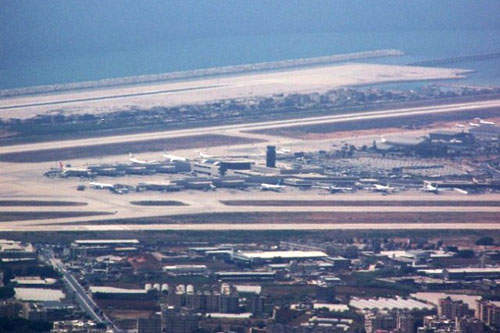


Beirut-Rafic Hariri International Airport, which was renamed from Beirut International Airport in June 2005, is a vital facility that plays a major role in linking Lebanon with the outside world, benefiting the country’s business and tourism sectors. The airport is located in the Khaldeh suburb south of the capital and around 9km from downtown Beirut.
On 25 January 2010 an Ethiopian Airlines flight, Boeing 737-800, crashed into the Mediterranean Sea shortly after taking off from the airport. Eyewitnesses saw the plane turn into a ball of fire before plunging 3.5km off the coast.
Recommended White Papers
Recommended Buyers Guides
The aircraft was carrying 90 passengers to Addis Ababa in Ethiopia. The cause of the crash is not yet known.
Opened in 1954, the airport was renovated in 1977 and the present runways were rehabilitated between 1982 and 1984 (missile attacks in the 2006 Lebanon-Israel conflict caused significant damage to the three operational runways, which caused the airport to be closed from July 2006 to mid-August 2006).
The first phase of the new airport began in 1994, and it was inaugurated in 1998. The second phase was completed by June 2000. Combined, these projects cost around $450m, funded by the European Bank for Investment and the Kuwaiti Fund for Arab Economic Development.
Payments for completed projects were taken from a fund made up of airport taxes and fees, based on the assumption that airport revenues should increase with the development of air travel and the increase in passenger numbers. The airport handled five million passengers in 2009 while aircraft movements in the same year were 57,543.
The airport is owned and operated by the Directorate General of Civil Aviation (DGCA), Lebanon. The airport is maintained by the Middle East Airports Services (MEAS), which is owned by the national carrier, Middle East Airlines (MEA).
Phase 1 runways
The first contract, awarded to the Fahmi Karagulla Contracting Group, included the construction of a new eastern runway (03/21) (take-off runway), which was worked on from 1994 until 1997 at a cost of $60m. The new 03/21 runway is 3,800m (12,467ft) long and 45m wide with two asphalt sides each 7.5m wide (the old 03/21 runway is now used as a taxiway).
In addition a new landing runway (17/35) was constructed at a length of 3,395m (11,138ft) protruding into the sea. This protrusion into the sea was part of the design in order to move landing traffic away from the city to improve safety and also reduce aircraft noise.
Designed so that planes do not have to stop and turn before leaving the landing zone, the new 17/35 runway can accommodate a touch-down every three minutes, twice as fast as the airport’s other runways. Work on this phase of the project included the diversion of Al Ghadir River and the building of installations on the Al Qassis Canal, used for draining rain water from the southern suburb.
Water channels were installed to divert two rivers away from the airport, and coastal land along the Khalde highway was developed to accommodate further expansion projects. A service road on the eastern side of the airport was also opened, connecting the new runway to the air plane parking zone.
Phase 2 terminal building
In 1994, Hoktef and CCC were awarded the largest contract, worth around $390m, for the redevelopment of the terminal building.
Before planned work began, a preparatory period extending over a number of months saw the construction of a centre for representatives of the consultants, officials from the Civil Aviation Directorate and the Council for Development and Reconstruction, as well as the preparation of Ouzai port to store the necessary demolishing material and equipment. The project also required the appropriations of around 800,000m² of land costing $160m.
Phase 2 also included the rehabilitation of a number of buildings, including the structures hosting electric generation and air conditioning, the aviation safety centre, the civil aviation workshop and garage, the firefighting training centre, and customs, freight and catering buildings.
New construction projects were sanctioned for a private aviation building, a VIP building, a building with a parking for 2,200 cars and a building for sorting mail. New buildings combined to bring up the total area for the terminal to 150,000m².
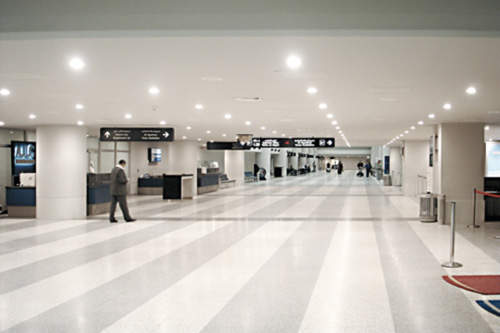
By 1998, the first phase of the new terminal had been completed. The four-storey building was located just to the east of the old terminal building and houses gates 1-12. Following the inauguration of the new facility the old terminal was demolished and construction on the western section (phase two) began, which was itself completed in 2000 but not inaugurated until 2002. This facility housed gates 13-23 (21 have jetways of which gates 2 and 3 have dual jetways and two are bus gates).
The terminal’s current capacity is approximately 3.5 million a year and is expected to be able to handle 16 million passengers by 2035 (more expansion will be required).
The airport’s general aviation terminal (GAT), built to accommodate VIP passengers and charter flights opened on 17 June 2005. The GAT is on the north-western corner of the airport and has state-of-the-art facilities. Future plans may involve the construction of 12 hangars and seven new gates to accommodate superjumbos such as the A380. The old 17/35 runway will also be refurbished and new taxiways will be constructed.
Terminal features
The departure area in the airport terminal features two airline lounges, a bank and four ATMs. The airport also has ramps and elevators. Other facilities include healthcare services, lost and found, postal services and internet access.
The airport has a 4,500m² retail space. In 1996 The Lebanese Government awarded a contract under a BOT basis to Phoenicia-Aer Rianta, a joint venture between Aer Rianta International Middle East and Beirut-based Phoenicia Trading Afro Asia, to manage and operate the retail area.
Baggage handling systems
MEA implemented a new baggage management system at the airport on 11 January 2010. The system was developed by an IT company, SITA, and is the first of its kind in Lebanon.
The system is called BagManager and BagMessage. BagManager manages the baggage through an interface with check-in and baggage sorting systems. It integrates with WorldTracer, an automated service featuring a single and shared lost baggage database.
CUTE system integration
In 1998, the airport selected SITA to install the CUTE (common-use terminal equipment) system to automate its passenger processing operations.
The system is designed to improve the efficiency and speed with which passengers can be checked in, particularly in an environment where passenger numbers at the airport are increasing year after year. CUTE works as a passenger management system and enables airlines and their handling agents to access their own applications in real time across a shared network and shared set of terminal equipment.
