
Nasa has selected four organisations to work on developing advanced oxygen recovery and recycling technologies to facilitate deep-space human exploration.
The space agency will award $750,000 each to Nasa’s Glenn Research Center in Cleveland, Oregon-based UMPQUA Research and University of Texas at Arlington in phase 1.

Discover B2B Marketing That Performs
Combine business intelligence and editorial excellence to reach engaged professionals across 36 leading media platforms.
The project is part of Nasa’s efforts to increase oxygen recovery rate on-board a spacecraft to around 75%.
Nasa Space Technology associate administrator Michael Gazarik said: "Improving oxygen recovery while achieving high reliability is critical for any long-duration human spaceflight missions where oxygen resupply from Earth isn’t available.
"These ambitious projects will enable the critical life support systems needed for us to venture further into space and explore the high frontier and are another example of how technology drives exploration."
The organisations will have 15 months to carry out the engineering development unit hardware phase.
Nasa’s Glenn Research Center will receive funds for its works on oxygen recovery from carbon dioxide using ion exchange membrane electrolysis technology, and combined solid oxide co-electrolyser and carbon formation reactor system for spacecraft life support oxygen regeneration.
UMPQUA Research will develop continuous Bosch reactor, while the University of Texas will work on micro-fluidic electrochemical reactor for oxygen recovery using carbon dioxide electrolysis.
The programmes selected under phase II will receive $2m each to develop prototype hardware over a two-year period.
Nasa said that these technologies would use the International Space Station National Laboratory as a base to evaluate the capabilities required for deep-space exploration.
The agency’s Langley Research Center in Hampton, Virginia is managing the contracts under the Game Changing Development Program within Nasa’s Space Technology Mission Directorate.
Nasa’s Space Technology Mission Directorate is designed to advance technologies for future space missions beyond low-Earth orbit.
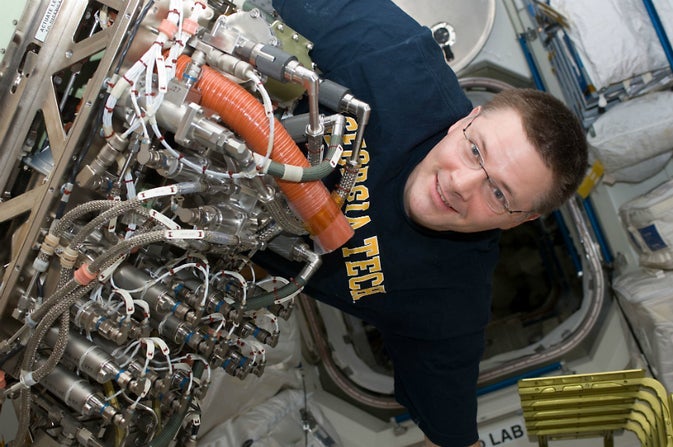
Image: Installed in 2010, Sabatier system in the International Space Station creates water from the by-products of the station’s oxygen generation system and carbon dioxide removal assembly. Photo: courtesy of Nasa.



