

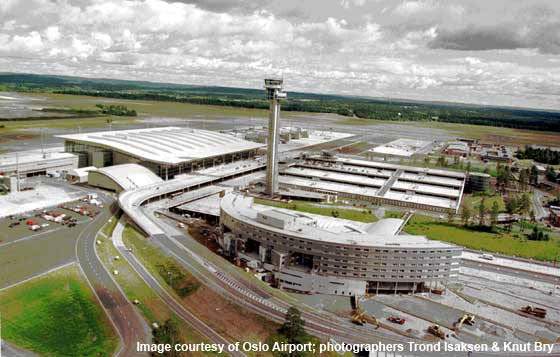
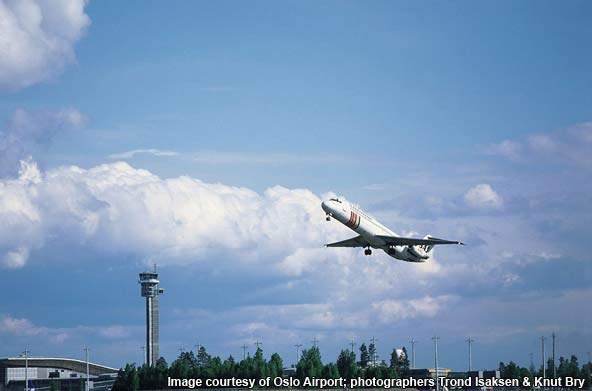
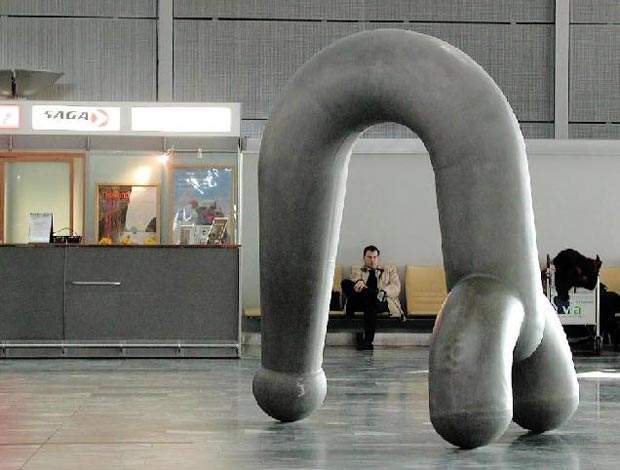
Gardermoen Airport, near Oslo in Norway, began construction in 1994 to accommodate the expansion in Oslo’s air traffic. The location of the airport was controversial, requiring many years of discussion before it was decided to build at its current site. The airport was designed with expansion in mind in order to avoid disputes over moving site in the future.
The airport is located in Gardermoen in Ullensaker, Norway, 48km north of Oslo, and has two parallel runways. The airport transport infrastructure is served by European route E6 and the connection to Oslo is via a high-speed train service that takes 19 minutes for the journey to Oslo’s central station.
Recommended Buyers Guides

Gardermoen took over as the main Oslo airport in October 1998, when Fornebu Airport was closed. The transfer happened overnight, and was a major operation. The airport cost an estimated $3bn to construct.
Around 21.1 million passengers travelled through the airport in 2011 with 223,565 aircraft movements.
Airport facilities
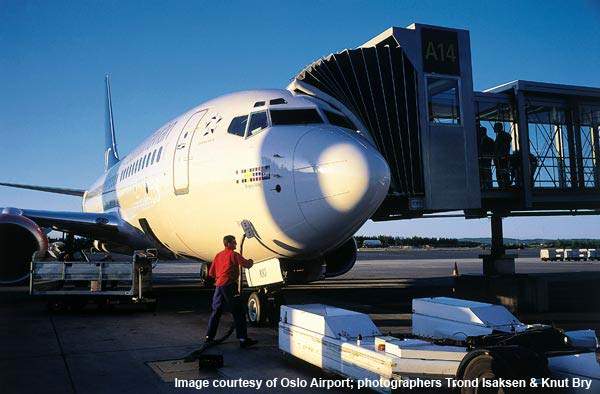
The airport has two parallel runways of 2,950m and 3,600m, 34 passenger bridges and five commuter stands, 64 check-in counters and 71 aircraft stands. A third runway has been proposed for future expansion but this is on hold until 2030.
In January 2006, Europe’s first infrared de-icing hangar at Oslo Airport was opened. The hangar will prove to be an invaluable supplement to standard de-icing for winter 2006.
Gardermoen also has the largest tax-free shop in Europe. This is due to the fact that Norway is not an EU member, and can still sell goods tax free. You may also buy tax-free goods as an arriving passenger. The main terminal building at Oslo Gardermoen Airport, completed in 1998, is the largest laminated wood structure in the world.
A multi-storey car park P10 was opened next to the terminal in November 2007. The project increased the total parking spaces at the airport from 3,400 to 6,000.
Gardermoen architecture
Following the Norwegian Parliament’s decision to make Gardermoen Airport the principal airport in eastern Norway, a company (Oslo Lufthavn) was established in 1992 to build the new terminal, which was called the Oslo Hovedflyplass.
The company commissioned the terminal design from Aviaplan, a joint venture including three architectural practices from Oslo (Narud-Stokke-Wiig, Niels Torp and Hjellnes Cowi) and one from Copenhagen (Skaarup & Jespersen).
Aviaplan turned to the consulting services of three more companies for the project, including Ove Arup, who was concerned mostly with the structures. The partnership made the most of each member’s specific expertise in response to a programme defined by the client, Oslo Lufthavn.
Airport terminal layout and structure
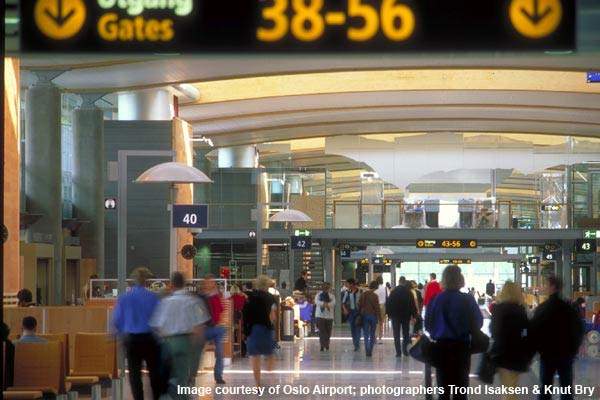
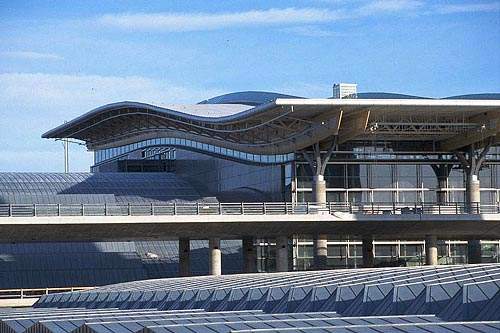
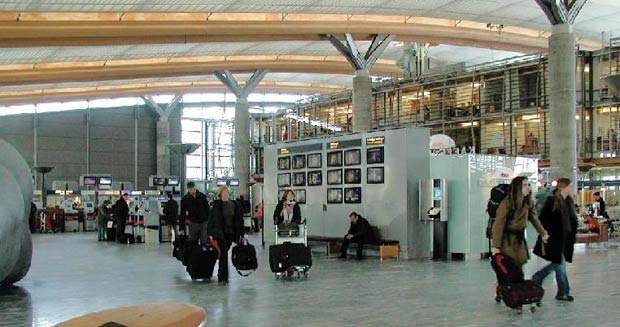
The main terminal is positioned in the centre, and contains ticketing, check-in counters, security, and commercial and service facilities. The departures area on the upper level consists of large open spaces taking advantage of the building’s full height, which is then topped by an undulated roof, rising toward the north facade.
The arrivals area on the lower level is a hall, two storeys high. On either side of the central construction are two buildings linking the main terminal with the planes, containing waiting areas at each gate, structured on two levels to separate the flow of arriving and departing passengers.
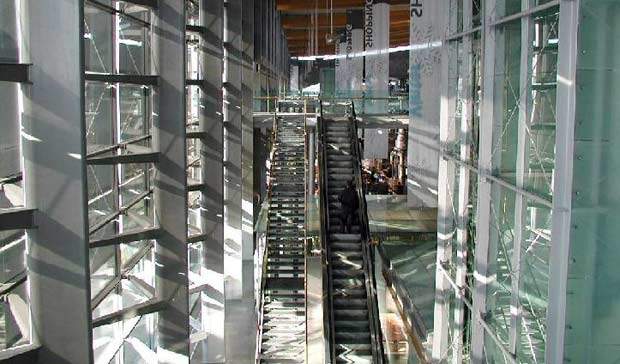
Passengers embark and disembark along a series of galleries made entirely out of glass. The building’s large transparent surfaces allow people in the building to be aware of their position with respect to the outside.
The roof of the central building has ten pairs of wooden beams each supported by three solid columns; the secondary structure connecting the pairs of beams is partially visible through the false ceiling, which consists of a perforated metal grid. The grid allows natural light to filter in from above while also reflecting artificial light from below the false ceiling.
The enormous ceiling is conceived as a form of decoration for the interior space, featuring the same colours, designs and materials as the interior of the large hall.
In the landscape defined by Oslo Airport, two accessory projects stand out by contrast: the roof of the railway station, with the characteristic form of a dragon’s back, and a series of utility areas for the car parks.
The latter project, by Jensen & Skodvin, stands out for its essential design and unusual cantilevered roofs at the entrances to the parking lots.
Bolseth Glass provided the architectural glass for the terminal which was built by OSL. The heating system for the airport was based on a district heating network relying on heat produced from bioenergy. The system, installed by the company Gardermoen Fjernvarme (GFAS), was built at the same time as the airport and its related infrastructure.
The airport opened to air traffic in October 1998, but the heating system was started up a year earlier and used during the construction of the new buildings. Raytheon Electronic Systems (RES) was selected by Oslo Lufthavn to supply integrated controller workstations for the tower and ramp operations for the airport.
In May 2009, an extension of the terminal was opened. The extension added 2000m² of space on each of the upper and lower levels of the terminal. A new baggage handling system with a capacity of 1,200 baggage units per hour and 14 new check-in counters were also added. The expansion increased the capacity of the terminal to 22 million passengers a year.
Expansion
The terminal building was originally designed to handle 17 million passengers. With increase in passenger traffic, the airport authorities commenced planning in 2007 to increase capacity. In April 2008, a conceptual solution including the construction of a new terminal and new pier was chosen.
Terminal 2 will be an extension of the current terminal enabling passengers to navigate through only one terminal. It will add 117,000m² of space to the existing 148,000m² and enable the airport to handle 35 million passengers per year. The proposal for construction of a new terminal was accepted by the authorities in February 2009.
The expansion project started in 2011 and will require an investment of €700m. A new 550m² extension of the current terminal as part of T2 expansion project was opened in June 2011.
Nordic Investment Bank (NIB) is partly financing the first phase of the project, which is expected to be completed by 2012. NIB granted a loan of €192m to Norwegian Avinor in October 2011 for construction of Terminal 2. The expansion is expected to be completed by 2017.
Baggage handling system
The contract for the baggage handling system was signed in June 1994. Vanderlande, a Dutch equipment manufacturer, was the chosen supplier. For departures and transfer baggage, a destination-coded vehicle system called Bagtrax was integrated to allow common check-in.
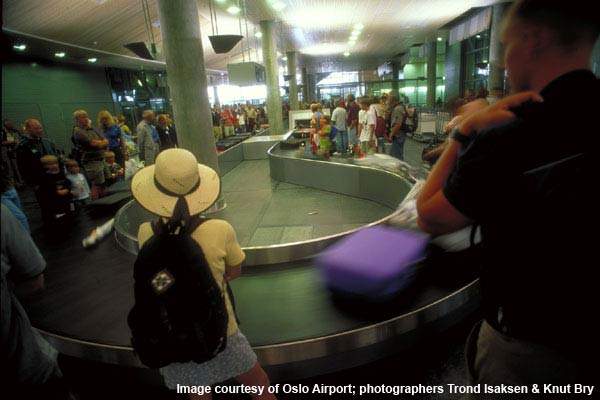
The Bagtrax system allows the transport of baggage on carts with speeds up to 8m/s to its final destination. The transport time for standard baggage is about 3-5 minutes. Conveyor belt lines connect the main baggage hall with each pier make-up zone; for arrivals, conveyor belt lines connect the piers with the reclaim carousels in the arrival hall.
The check-in comprises 64 positions for standard baggage, divided into three islands with 22, 22 and 20 desks. There is one oversize check-in desk per island.
From each island the baggage travels down, a spiral-shaped conveyor configuration through a Hold Baggage Screening (HBS) machine for first and second stage security, and finally reaches the main baggage hall. After HBS, all oversize baggage is sorted out by vertisorters to a conveyor system.
With this conveyor system, oversize baggage can be transported to the pier make-up zones west or east. Standard baggage is fed to a Bagtrax loading station, where each bag is loaded into an empty Bagtrax cart and then transported to the pier make-up zones.
Each zone has two unloaders each with 22 bins. Baggage trolleys, parked in front of the bins, are loaded manually. The Bagtrax cart speed is about 4m/s in the main baggage hall and about 6m/s in the pier make-up zones.
Security screening
All departing baggage, international as well as domestic, is subjected to security screening. The automatic first-stage screening clears most of the baggage. The remaining baggage is subjected to a second-stage screening by visual image verification.
All uncleared baggage is routed to the third-stage security area in the main baggage hall where it is removed by an operator. Transfer baggage is fed into the Bagtrax system after a 100% security check. Through the use of Bagtrax it is possible to transport transfer baggage from one pier to the other pier within five minutes.
